
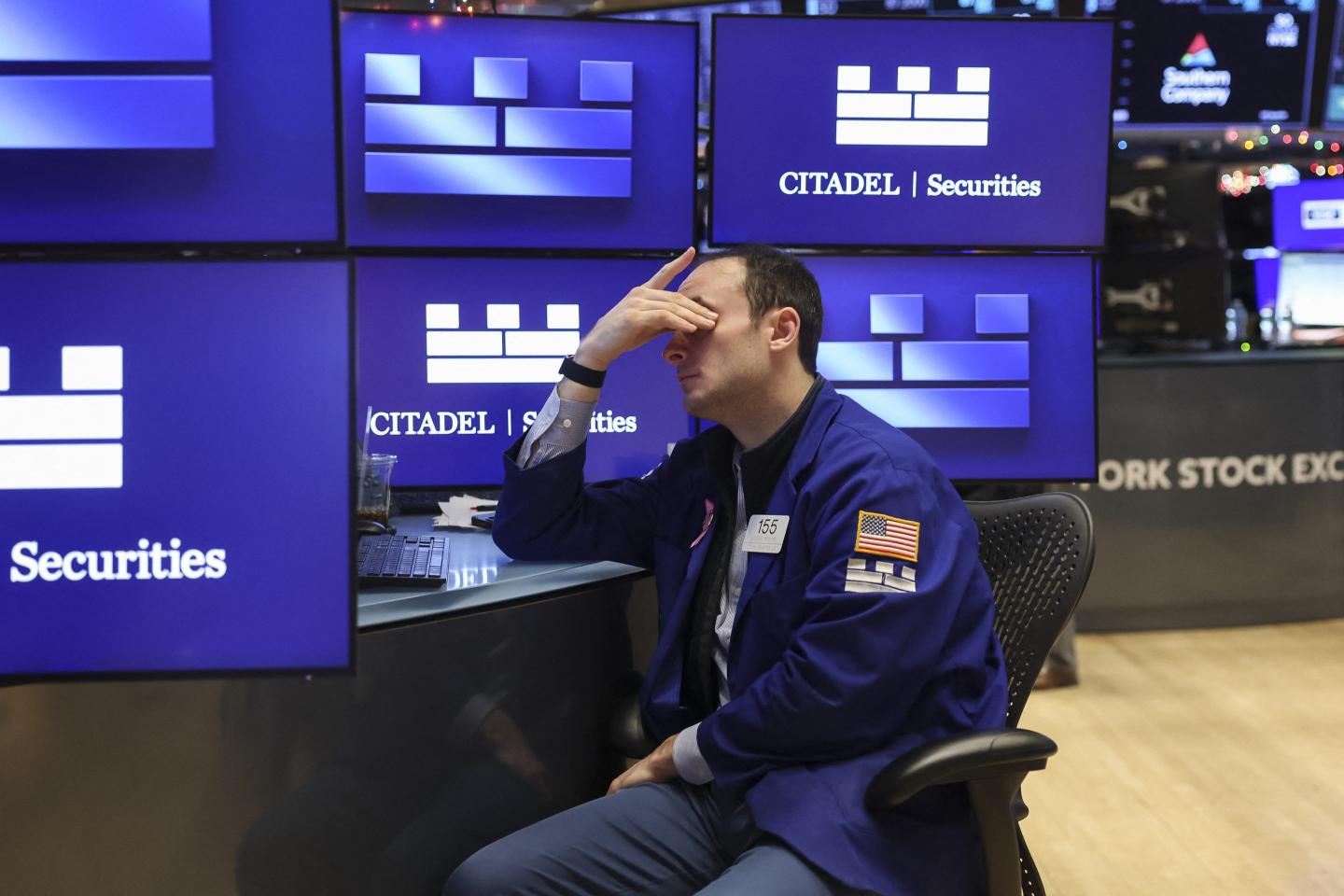
James Reilly, senior markets economist at Capital Economics, has reiterated his view that the current AI-driven surge in US equities resembles a late-stage bubble. He expects the S&P 500 to finish 2026 around 8,250, a gain of 7.7% from its recent level, before falling to roughly 6,500, a 21% drop, by the end of 2027.
Why the warning matters
The warning rests on several indicators that have historically preceded market peaks. The cyclically adjusted price-to-earnings ratio of the S&P 500 is now close to the level seen at the height of the dot-com boom, and the index's valuation relative to Treasury yields mirrors those extremes as well. Forward earnings growth expectations for the next twelve months also match the dot-com peak, suggesting that projected profit expansion may be unsustainable.
Another concern is the financing of AI projects. The combined free cash flow of the leading AI hyperscalers is projected to turn negative in 2027, raising doubts about the durability of massive spending in the sector. In addition, market-cap concentration has reached levels where a handful of stocks dominate the index, a pattern often linked to fragile rallies.
"On balance, we think the data look consistent with a late-stage bubble," Reilly wrote in a note on Thursday.
Equity issuance is also accelerating, with a pipeline of IPOs and follow-on offerings that historically signal a bubble's end within months rather than years.
What could trigger the crash
While Reilly did not directly reference Treasury yields, Ruchir Sharma, chairman of Rockefeller International, has highlighted the 10-year US Treasury rate as a critical threshold. In a recent op-ed, Sharma warned that a decisive breach of the 5% level, a ceiling that held during the dot-com era, would usher in a new period of tighter money, making large AI projects harder to fund.
Higher borrowing costs would likely curb bond issuance by hyperscalers and dampen equity financing, as yields above 5% have historically acted as a headwind for stock markets. Moreover, yields approaching nominal GDP growth would exacerbate concerns about the sustainability of the US national debt, which now exceeds 100% of GDP.
Wall Street veteran Ed Yardeni has also adjusted his outlook, lowering the probability of a "Roaring 2020s" scenario from 80% to 70% and raising the odds of a bearish outcome from 20% to 30%.
"Admittedly, recent developments in the oil and bond markets are unnerving," Yardeni said in a note on Saturday.
What to watch next
Investors should monitor the 10-year Treasury yield closely; a sustained move above 5% could act as the catalyst that turns the AI-fuelled rally into a sharp correction. At the same time, the flow of new equity offerings will provide clues about whether market participants are still confident in the sector's growth prospects.
For now, analysts suggest that the final months of 2026 may offer the last window of upside before the market potentially turns. Those with exposure to AI-heavy stocks should assess the risk of a rapid re-pricing and consider diversifying away from the most concentrated positions.