
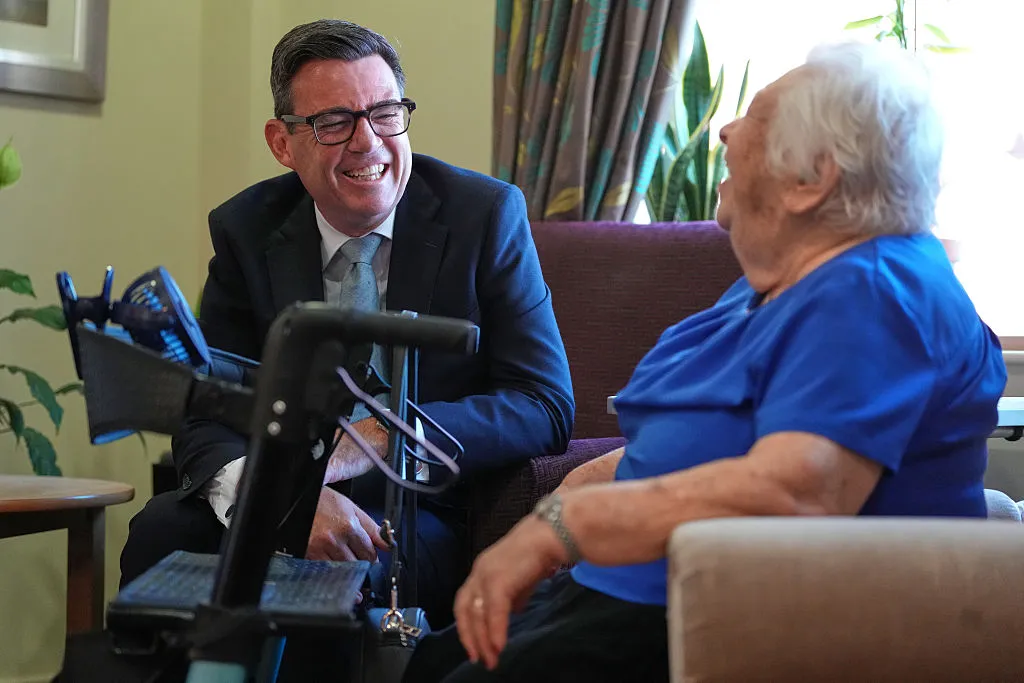
Paul Sagar, a reader in political theory at King's College London, has laid bare the structural failures of Britain's social care system in a personal account that connects his own life as a tetraplegic patient to the political choices facing the new government. His analysis frames the crisis as a trilemma: the British public wants high-quality care, low taxes and reduced immigration, yet satisfying all three is mathematically impossible.
The trilemma at the heart of social care
Sagar argues that improving care requires either raising wages to attract domestic workers, which demands higher taxes, or keeping wages low and relying on migrant labour, which conflicts with immigration reduction targets. He notes that the NHS would collapse without immigrant staff. The academic, who describes himself as a "wet centrist of dad-age", says he would accept higher taxes to fund better pay, not primarily to curb immigration but because higher wages would attract more competent carers regardless of origin.
Lived experience of a broken system
In 2023 a rock-climbing accident left Sagar paralysed from the collarbones down. He spent eight months in hospitals and four months in a nursing home in Enfield, then returned to Waltham Forest with 24-hour care. He acknowledges he has been fortunate: his local authority approved funding for a specialist spinal-injury agency that pays staff well and rejects unsuitable candidates. That agency's higher fees translate into better recruitment and retention.
"If the worst three words in the English language are 'rail replacement bus', then the most terrifying for a long-term hospital inpatient are 'agency staff'."
By contrast, Sagar recounts a friend with nearly identical needs who has been moved between large agencies for three years. That friend, who asked not to be named for fear of recrimination, describes carers who ignored screams during a catheter emergency, walked away mid-conversation because they could not understand English, and refused to unblock a catheter despite warnings of autonomic dysreflexia, a life-threatening condition. Complaints to the agency produced no change.
Private equity's extractive model
Sagar argues that the dominant model for large-scale provision is extraction. Private equity-backed agencies maximise revenue by minimising wages and training, exploiting visa exceptions for care work to recruit overseas staff who may lack language skills. Local authorities, hollowed out by two decades of austerity, cannot monitor quality effectively. Contracts are awarded to whoever promises coverage at the lowest price.
"Money in the bank, Frank."
He stresses that not all providers are predatory. Smaller, locally managed agencies and specialist operators without private equity backing often deliver excellent care. The problem is systemic: the market rewards cost-cutting over quality.
Burnham's challenge and the zombie-neoliberal legacy
Andy Burnham, now leading the government's social care agenda, has ruled out tax rises while promising higher pay for care workers. Sagar calls this "vibes and no concrete policy". He traces the failure to what he terms "zombie-neoliberalism": the legacy of Margaret Thatcher and Tony Blair processed through austerity. The result, he says, is a system where higher taxes fund private profits while the most vulnerable receive substandard care.
"Burnham in his first week declared that he wanted to reverse 40 years of neoliberalism. There are good reasons to think he's using the wrong word here: neoliberalism started to die in 2008, and has been dead as a dodo since 2016. What we currently live under is something worse. Zombie-neoliberalism: the legacy of Margaret Thatcher and Tony Blair fed through the meatgrinder of austerity."
Sagar argues that breaking the trilemma requires both raising care wages and removing private equity from large-scale provision, though he stops short of advocating full nationalisation. He warns that vested interests will fight reform fiercely and questions whether the prime minister has the courage to confront them.
What happens next
The government faces a narrowing window. Demographic ageing will increase demand for care while the workforce shrinks. Without a funding settlement that accepts higher taxation or a radical restructuring of provision, the reliance on low-wage migrant labour will deepen, and quality scandals will multiply. Burnham's credibility, and the wellbeing of hundreds of thousands of care recipients, depend on whether the administration can translate rhetoric into a financially honest, structurally sound plan.