
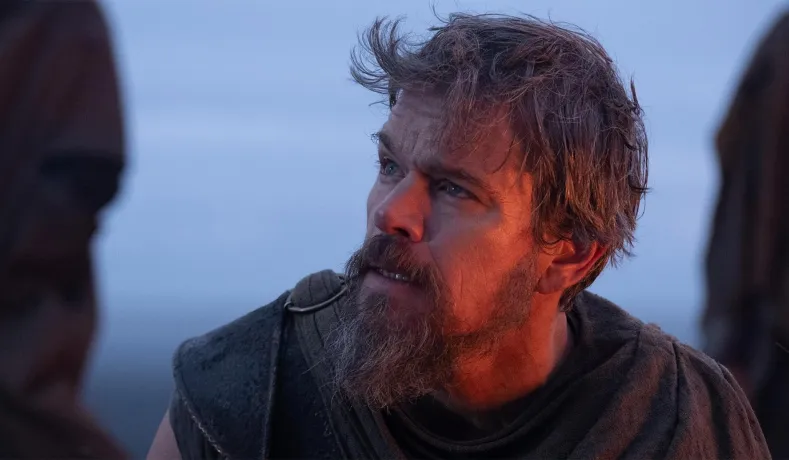
A wave of Odyssey mania is set to crest this week as Christopher Nolan's new adaptation reaches cinemas across Europe. Yet audiences who expect the familiar marble columns and rational debates of classical Athens will find something far older and stranger. The poem does not belong to the world of Plato, Aristotle or the Persian Wars. Its events unfold in the late Bronze Age, roughly 1200 years before the golden age of Attic culture, and its written form predates even the Olympic Games and the lyric poets Sappho and Alcaeus.
A world before "Greece"
Homer barely uses words that mean "Greek" or "Hellenic". The Iliad and Odyssey depict a patchwork of tiny Mycenaean kingdoms whose warriors wear boar's tusk helmets, fight with bronze weapons and record the little they write in Linear B, a script deciphered only in the 1950s. This is not the civilisation that gave Europe democracy, geometry and formal philosophy. It is a darker, more fragmented world where survival depends on a different kind of mind.
Odysseus and the intelligence of metis
No figure illustrates the gap between the Homeric and the Attic worlds better than Odysseus. The Athenians admired his cleverness but often despised his lack of scruple. Pindar suspected his fame exceeded his labours thanks to Homer's sweet lays. Sophocles had Philoctetes denounce him as a shameless wretch from whom neither truth nor justice could flow. Even Socrates, in the Lesser Hippias, declined to defend him outright, preferring to show that his interlocutor was just as deceptive, only turned inward.
What unsettled these rational minds? In the 1960s and 1970s the French classicists Jean-Pierre Vernant and Marcel Detienne offered an answer. Where Plato and Aristotle prize nous, logos and episteme, faculties that grasp a stable, intelligible order, Homer reaches for metis. This word denotes a practical, flexible intelligence, as variegated as light on bronze armour, the uncanny knack of getting things done when reality refuses to follow a plan.
Knowhow that cannot be codified
Throughout the Odyssey, Homer lingers over Odysseus's feats of craft as lovingly as the martial exploits of Achilles or Hector. In Book 5 he fells trees, bores joints and builds a raft with his own hands, steering by the stars. In Book 21 he strings his great bow "like an expert singer skilled at lyre and song". In Book 23 we learn he carved his marriage bed from the living trunk of an olive tree. Even the scar by which Eurycleia recognises him testifies to a distinctly non-Mycenaean skill: hunting boar.
The crucial difference, Vernant and Detienne argue, lies in the relationship between metis and its own representation. For Plato, a spoken or written account of the truth is the truth. Metis, by contrast, evaporates the moment you try to write it down. Odysseus's plans are never neat step-by-step lists; they are provisional, revised when a cyclops blocks the cave door or a sea-god smashes the raft. In Book 13 Athena explicitly admires this quality. Meeting him in disguise on Ithaca's shore, she delights that he begins to lie before he knows why, trusting that pretence may prove useful in future improvisations. "Here among mortal men you're far the best at tactics, spinning yarns, and I am famous among the gods for wisdom, cunning wiles [metis] too," she tells him.
The mythic roots of metis
The word choice is no accident. In Greek theogony metis is also the name of Athena's mother, the Oceanid nymph who married Zeus in the primordial age of the Titans. Hesiod records that after the wedding a prophecy warned: Metis would bear a daughter equal to Zeus in wisdom and a son who would overthrow him. Zeus swallowed her whole, "put[s] her away inside his own belly … so that this goddess should think for him, for good and for evil". The message is clear: patriarchal authority and abstract Apolline knowledge may rule, but to remain king of the gods you must internalise the most mysterious, unrepresentable intelligence of all.
Modern admirers and the anti-capitalist hero
Twentieth-century readers singled out something like metis as uniquely suited to the modern age. James Joyce, who reimagined Odysseus as the advertising agent Leopold Bloom, stressed his completeness and adaptability: son, father, husband, lover, companion, king, all combined to make him the "most human" character in world literature. In The Human Condition Hannah Arendt went further, suggesting the Homeric ethic as an anti-capitalist strategy. She noted that Paris and Odysseus help build their own houses and Nausicaa washes her brothers' linen, a self-sufficiency that grants the hero autonomy and supremacy of person.
The bureaucratic heir that cannot produce an Odysseus
Yet reading Joyce and Arendt today feels slightly unfamiliar. The jury has decided that the Greek ideal means top-down planning, rational bureaucracy, vast sovereign efforts to make the world conform to abstract standards. For Le Corbusier those ideals justified razing half of Paris for Parthenon-esque cuboids; for contemporary politicians "democracy" justifies an increasingly inane proceduralism. The rational institutions that claim the Greek inheritance, democratic halls, geometrical housing estates, universities with Greek letters on their porticoes, seem less capable than ever of producing a single individual as well-rounded, as universally capable, as polymetis, as Odysseus.
Why the mystery matters now
If the coming wave of Odyssey enthusiasm achieves anything, it should remind Europe that its intellectual legacy is far more mysterious than the culture likes to remember. The importance of un-representable knowledge is hard to discern in the philosophers of golden-age Athens, though even Plato gave rationality its place, devoting much of the Phaedrus to the revelatory power of the mania induced by poetry, sex and wine. The further back you go, the clearer the mystery becomes: Pythagorean geometers guarded the secret of irrational numbers and drowned Hippasus for revealing it; Orphic cults withheld wisdom from anyone who had not undergone elaborate purification. But the earliest Greek writer of all captured it best. No one since, in any language, has better rendered the essential wildness of the human intellect, its storminess, its amplitude, matched only by the wine-dark sea.