
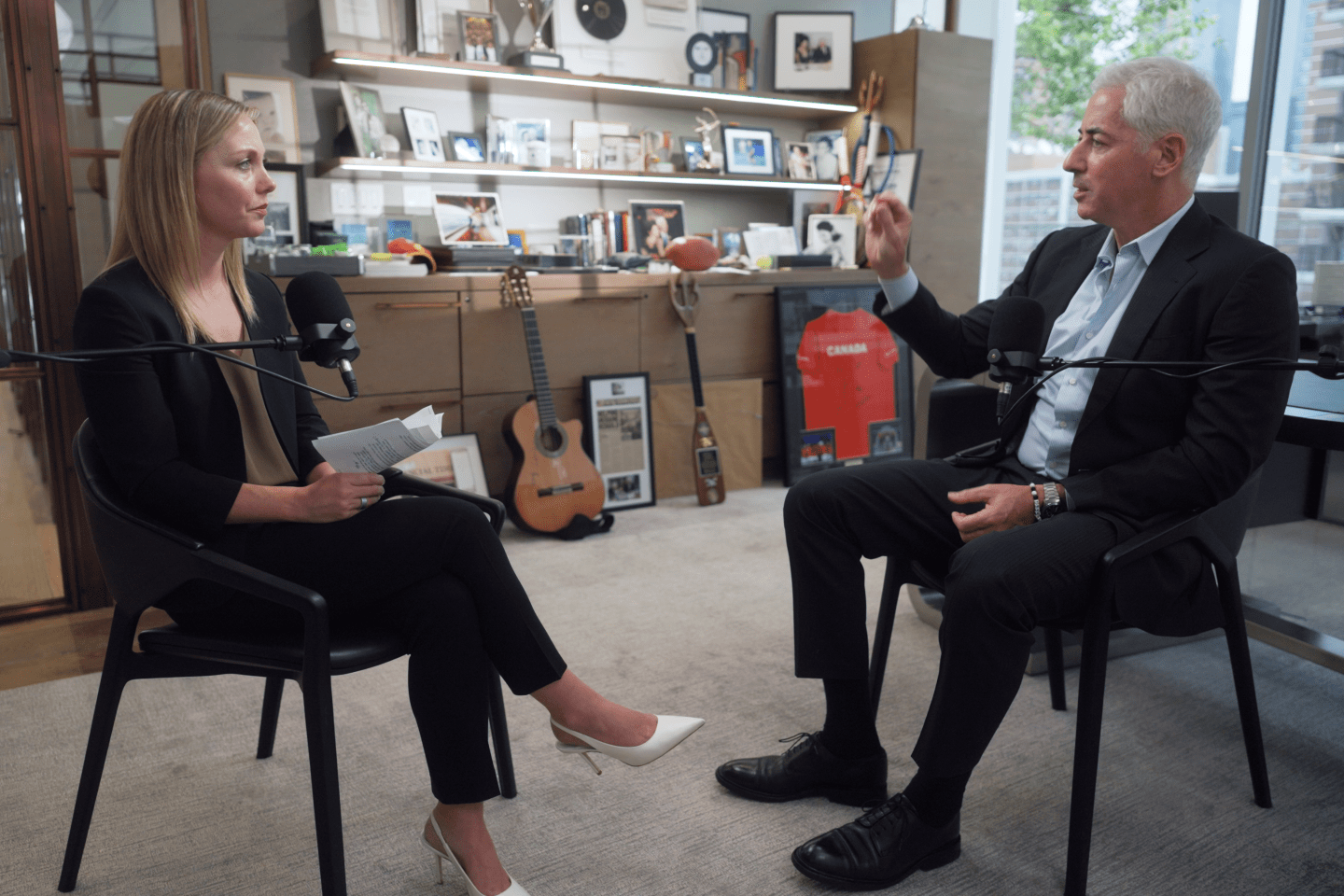
Bill Ackman sat down with EuroHerald's editor-in-chief Alyson Shontell for a deep-dive into the hedge fund founder's career, his outlook on artificial intelligence and his outspoken political views. The conversation covered the dramatic rescue of Pershing Square, the rationale behind his latest stock picks and his belief that socialism would harm Europe's economies.
From near-bankruptcy to a $8 billion empire
Ten years ago Pershing Square faced a crisis that threatened to end the firm. A $4 billion loss on the Valeant Pharmaceuticals investment, compounded by a short position on Herbalife and a personal divorce, drove investors to redeem capital. Ackman secured a $300 million unsecured personal loan from J.P. Morgan, used it to buy a controlling stake in Pershing Square Holdings and turned the firm into a permanent-capital vehicle. He says the episode taught him that "daily progress, however small, compounds over time."
"I borrowed $300 million, bought enough of our own stock and locked in permanent capital. That was the turning point," Ackman said.
The strategy paid off. After the crisis the fund rebuilt assets to roughly $35 billion and posted its best eight-year run in history.
Why certain stocks are now attractive
Ackman explained that today's market is dominated by a handful of large tech firms whose growth outpaces the broader index. He argues that the S&P 500's market-cap weighting means high-growth companies such as Microsoft, Amazon, Meta and Uber are undervalued relative to their long-term prospects. Uber, he notes, is cheap because investors fear a potential Tesla robotaxi takeover, even though the ride-hailing platform also runs a fast-growing food-delivery business.
He added that the current focus on semiconductor makers has diverted attention from these "durable-growth" stocks, creating buying opportunities for investors who can look beyond the chip hype.
Private-market IPOs and the AI frontier
When asked about trillion-dollar listings, Ackman cautioned that price matters more than hype. He highlighted SpaceX as a company with a dominant cost advantage in launch services and a growing broadband arm, Starlink, which he personally uses. He also mentioned his personal stakes in X and xAI, noting that private-market exposure is now a key way for him to stay ahead of public-market trends.
Regarding frontier AI firms, Ackman said Anthropic appears to be scaling profitably, while OpenAI's model of heavy cash burn raises questions about long-term financing. He warned that "the biggest risk is investing in businesses that need ever-increasing capital without a clear path to cash-flow positivity."
Outspoken views on politics and economics
Ackman does not shy away from controversial topics. He told Shontell that his comments on diversity, equity and inclusion (DEI) and elite universities are not calculated moves but genuine convictions. He also described his relationship with former President Donald Trump as "excellent" because he tells the president the truth, even when it is uncomfortable.
"Socialism is a disaster," Ackman said, adding that policies that restrict housing construction or freeze rents, as he sees in New York City, exacerbate affordability problems.
He argues that capitalism, when disciplined, creates more jobs than philanthropy and that a universal "baby-account" with a $6,500 start-up sum could help close the wealth gap.
Philanthropy meets for-profit innovation
Ackman's latest charitable venture is the Brain Research Rehabilitation Institute, a hybrid model that uses nonprofit capital to launch for-profit spin-outs targeting brain-injury treatments. He believes this approach combines the mission-driven focus of charities with the efficiency of market incentives.
What lies ahead for Pershing Square
Pershing Square now employs about 48 people, most of whom own significant equity in the firm. Ackman stresses a culture of "extreme candor" and long-term compensation tied to the overall portfolio, not individual P&L. He plans to continue expanding the permanent-capital structure, using the public listing of Pershing Square Inc. and Pershing Square USA to give investors access to a low-fee, long-term hedge fund.
Looking forward, Ackman sees artificial intelligence reshaping education and healthcare, making expert-level advice freely available. He expects the cost of intelligence to keep falling as more open-weight models emerge, eventually delivering "superintelligence" at near-zero cost to most users.
In summary, Ackman's interview offers a rare glimpse into the mind of a billionaire who has survived near-ruin, built a diversified investment platform and remains unafraid to voice controversial opinions on politics, economics and the future of technology.