
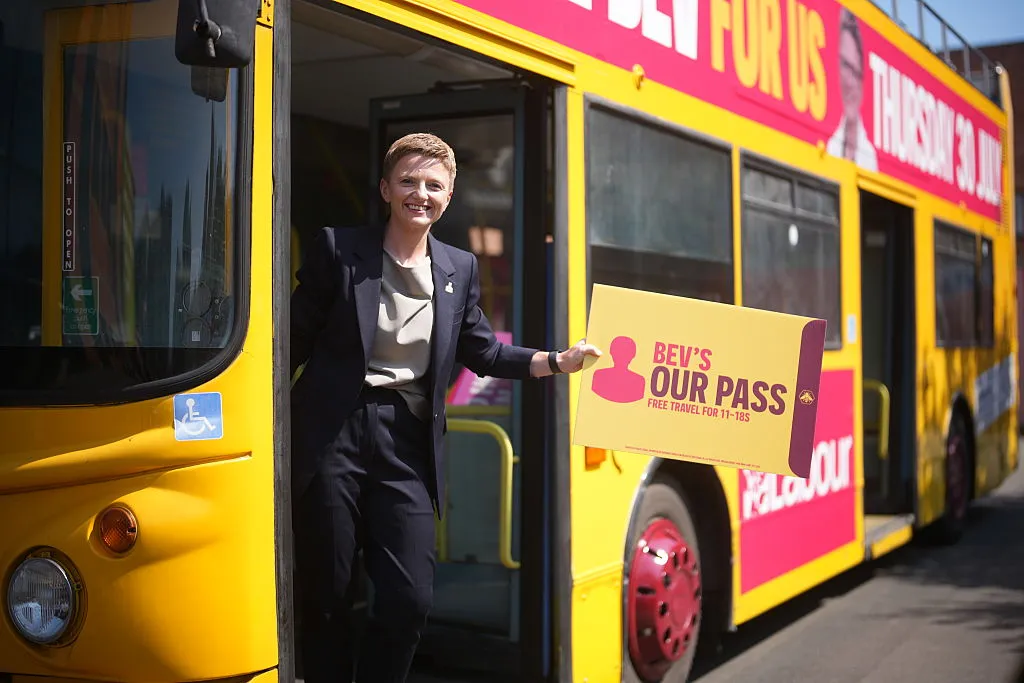
Andy Burnham has tightened his grip on Greater Manchester politics after his chosen successor Bev Craig captured the mayoralty with a commanding 66.3% of the vote in the second round, reversing the alarm Labour strategists felt only months ago when Reform UK topped polling across the city-region.
From Red Fortress to contested terrain
In January, members of Labour's National Executive Committee privately briefed that Burnham could not be allowed to stand as a parliamentary candidate in Gorton and Denton. Their calculation was blunt: if he resigned the mayoralty, a by-election might hand the post to Reform. The briefing inadvertently revealed the party's fragility. In the 2024 mayoral contest, Burnham had carried 214 of 215 Greater Manchester wards, a dominance that would give a single party a legislative supermajority exceeding that of the Chinese Communist Party in Beijing.
Manchester's Labour allegiance predates the party itself. The region was a crucible of Chartism, radical liberalism and industrial trade unionism long before the Labour Representation Committee formed. Burnham consolidated that heritage into what allies called an impenetrable Red Fortress, winning even affluent suburbs on the Pennines fringe. Yet the unpopularity of Prime Minister Keir Starmer, barely eighteen months into his premiership, made senior Labour figures fear the fortress could fall to a national-populist tide unless Burnham himself remained on the ballot.
May's warning shot
The May local elections validated those fears. Across the ten Greater Manchester councils, Reform secured an aggregate 30% of the vote against Labour's 24% and the Greens' 20%. Labour failed to finish first in any single authority. The old electoral bloc had fractured under pressure from left and right populisms, a collapse attributed to a national leadership perceived as lacking purpose amid falling living standards.
A swift reversal
Three months later the picture has inverted. Craig took 47.2% in the first round and two-thirds in the runoff. The Greens, who had briefed they were in contention, were pushed into a distant third. The Liberal Democrats barely registered. Some soft Reform voters appear to have returned to Labour now that the national face of the party has changed. The coalition that delivered Burnham his 2024 landslide shows signs of reassembling.
New fiscal levers raise the stakes
The winner's mandate matters more because combined authorities are acquiring genuine fiscal power. A share of income tax receipts will be devolved, ending what West Midlands mayor Andy Street labelled a "begging bowl culture" of bidding for Whitehall grants. Two of the last five prime ministers used mayoralties as springboards to Downing Street; the office is no longer a ceremonial ambassadorial role.
The shift brings Britain closer to the norm in advanced democracies where city and regional leaders drive economic strategy. Zohran Mamdani, the New York mayoral candidate, has become a reference point for left-leaning strategists worldwide: a charismatic frontman, disciplined cost-of-living messaging, and vertical-video communication that bypasses traditional lobby journalism. Burnham is consciously mirroring that playbook.
Technocratic growth agenda
Behind the media strategy sits a substantive economic programme shaped by two senior advisers: former Goldman Sachs economist Jim O'Neill and former Bank of England chief economist Andy Haldane. Both have long argued that empowered city-regions unlock productivity. A recent paper co-authored by Ed Balls makes the case for intensified regional rewiring paired with infrastructure investment, £200 billion for transport outside London over two decades, with the prize of £70 billion annually in extra Exchequer receipts if second-tier cities match Western European counterparts.
Burnham's focus on devolution stands out in his premiership's early days. Public demand for stronger mayors is minimal; many voters feel equally alienated from town halls and Whitehall. His pursuit of the agenda reflects a convert's zeal. Traditional Labour hopes for renationalisation and state-led reindustrialisation will likely be disappointed. Burnhamism is technocratic: infrastructure, mass transit across the North and Midlands, and the "triple-helix" model linking local government, universities and business.
The spatial trap
The agglomeration model has already worked, for central Manchester. Three decades of investment produced a striking skyline around Piccadilly Gardens. It has not replicated in Rochdale, Leigh or parts of Oldham, where promised spillover never materialised beyond the improved Bee Network. Burnham held both constituencies simultaneously, champion of left-behind towns and architect of the glass-and-steel boom, without conceding that the growth model primarily benefits a northern laptop class. The question is whether that duality survives national scaling.
Cultural bridge or temporary truce?
Academic Paula Surridge's research shows a majority appetite for an active state and public investment. Yet Labour's potential voters split along cultural lines: patriotic, non-graduate working-class conservatives versus liberal-progressive graduate urbanites. Burnham attempts to bridge the gap with an inclusive social imaginary, dad-rock, football, pints, pies, professional northern cheek, moulded onto a vague social-democratic nostalgia. If it holds, the right has cause for alarm.
Right in retreat
Reform is in national disarray and has been roundly beaten in Greater Manchester, where it led in May. The party has lost its polling lead for the first time in over a year. The Conservatives have stabilised. The Greens and Liberal Democrats are receding. Burnham outpolls every rival leader by margins Starmer never achieved.
The contradictions within Burnhamism are real, but no more so than those fragmenting the right. Boris Johnson's 2019 coalition of post-industrial proletariat and affluent southern middle classes proved fleeting. Those blocs have since bifurcated into a plebeian populist movement and a rump of conservative ultra-loyalism.
The autumn test
In 2007, a new Labour prime minister with an inherited mandate and a commanding lead declined an early election. Burnham was in the Treasury at the time. He now occupies a similar position. He can extend his lead, provided he maintains his everyman ambiguity and the difficult-decision-free space that lets him ride two horses at once. That will be tested in September when Parliament returns and a Budget follows. The fiscal inheritance is perilous; promises will be broken. Downing Street is staffed by former Blairites; the Cabinet blends soft-left, Brownite and Blue Labour voices; backbenchers span Socialist Campaign Group, Progressive Britain and beyond. Elite contradictions mirror deeper demographic fissures. Greater Manchester taught Burnham the coalition can be rebuilt. Autumn will reveal how long it holds.