
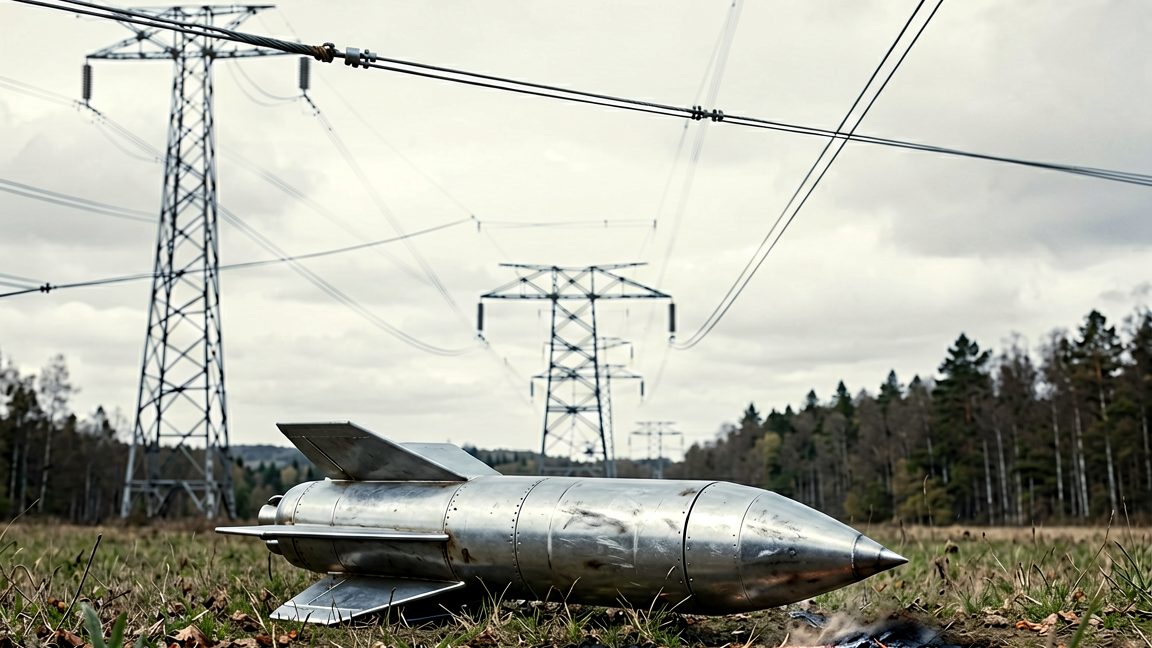
German Interior Minister Jan Redmann told the Brandenburg state parliament's interior committee on 2 September 2026 that unknown actors had deposited more than a dozen rocket-shaped sabotage devices beneath the region's 380 kV transmission lines, and that only a single device succeeded in establishing a conductive link to ground.
What was discovered
According to Handelsblatt, the objects were not ordinary fireworks. They resembled rockets and contained a propellant charge, a detail that suggests a degree of technical know-how beyond casual vandalism. The successful device managed to transport a cable into the overhead line, creating a short-circuit path to the earth.
The minister stressed the low success rate, out of at least twelve (the packet specifies ">12", i.e. ≥13) devices placed, only one achieved its intended conductive connection. This outcome, he said, constitutes a "serious security breach for the electricity grid".
Timeline of the incident
| Period | Event | Number of devices | Successful connections | Source |
|---|---|---|---|---|
| Early September 2026 (discovered 2 Sept 2026) | Placement of rocket-shaped sabotage devices under 380 kV lines | ≥13 | 1 | Handelsblatt, 2 Sept 2026 |
The packet's timeline records two steps: first, unknown actors placed the devices in early September 2026; second, on 2 September 2026, Minister Redmann briefed the interior committee, confirming the discovery and the low success rate.
Technical aspects of the devices
Handelsblatt's description of the objects as "rocket-like" with a propellant charge implies that the perpetrators possessed engineering capability. The propellant would allow the device to launch or position itself under the line, while the embedded cable suggests a deliberate attempt to bridge the high-voltage conductor to ground. The fact that only one device succeeded indicates either a flaw in the design or a deliberate limitation to avoid a larger outage.
Because the successful device created a conductive path, it could have caused a short-circuit, potentially triggering protective relays and leading to a local outage. The packet does not state whether any interruption occurred, but the minister's warning about a "serious security breach" underscores the risk of even a single successful link.
Security implications for Germany and Europe
Germany's high-voltage grid is a backbone of the European energy market. The 380 kV lines in Brandenburg feed both domestic consumption and cross-border exports. A sabotage that can create a ground-return path threatens not only local reliability but also the stability of interconnected markets.
European energy authorities have previously highlighted the vulnerability of critical infrastructure to covert attacks. The Brandenburg incident adds a concrete example of how relatively small, technically sophisticated devices can target key assets. It also raises questions about surveillance, rapid detection, and the adequacy of existing protective measures.
Official response and next steps
Minister Redmann's public confirmation signals that the federal and state governments will likely intensify investigations. While the packet does not detail the investigative agencies involved, the interior ministry's involvement suggests coordination with police, the Federal Office for the Protection of the Constitution (BfV), and the Federal Network Agency, which oversees grid security.
Authorities are expected to review surveillance footage, trace any procurement of propellant materials, and assess whether similar devices have been spotted elsewhere in Germany. The fact that the sabotage was discovered days after placement, as noted in the packet, points to a pre-planned operation rather than a spontaneous act.
Potential impact on consumers and industry
Even a single short-circuit can trigger automatic shutdowns of affected line sections. For industrial users in Brandenburg, such an interruption could disrupt production schedules, especially for energy-intensive sectors like chemicals and automotive parts. Residential consumers might experience brief outages, though the packet does not confirm any actual power loss.
From a market perspective, any perceived weakness in grid security can influence investor confidence in German energy assets. European grid operators may reassess contingency plans, potentially accelerating investments in redundancy and real-time monitoring technologies.
Broader European context
Sabotage incidents targeting energy infrastructure have risen across the continent in recent years, from attacks on pipelines to cyber-intrusions on control systems. The Brandenburg case aligns with a pattern of actors seeking to exploit physical vulnerabilities. While the packet does not identify the perpetrators, the technical sophistication implied by the propellant-charged devices suggests a group with access to specialised resources.
European Union bodies, such as the Agency for the Cooperation of Energy Regulators (ACER), have called for a unified response to such threats. The Brandenburg incident may become a case study in upcoming EU-wide security guidelines, reinforcing the need for cross-border information sharing.
What comes next?
Minister Redmann's briefing marks the first public acknowledgement of the sabotage. The next weeks will likely see a forensic analysis of the recovered device, a hunt for additional unexploded objects, and a tightening of security protocols around high-voltage infrastructure. Stakeholders, from grid operators to policymakers, will be watching closely to see whether the incident prompts legislative changes or increased funding for protective measures.
For now, the German interior ministry has not disclosed whether any arrests have been made or whether a specific group has claimed responsibility. As investigations progress, further details are expected to emerge, shaping the debate on how Europe safeguards its most critical energy arteries.