
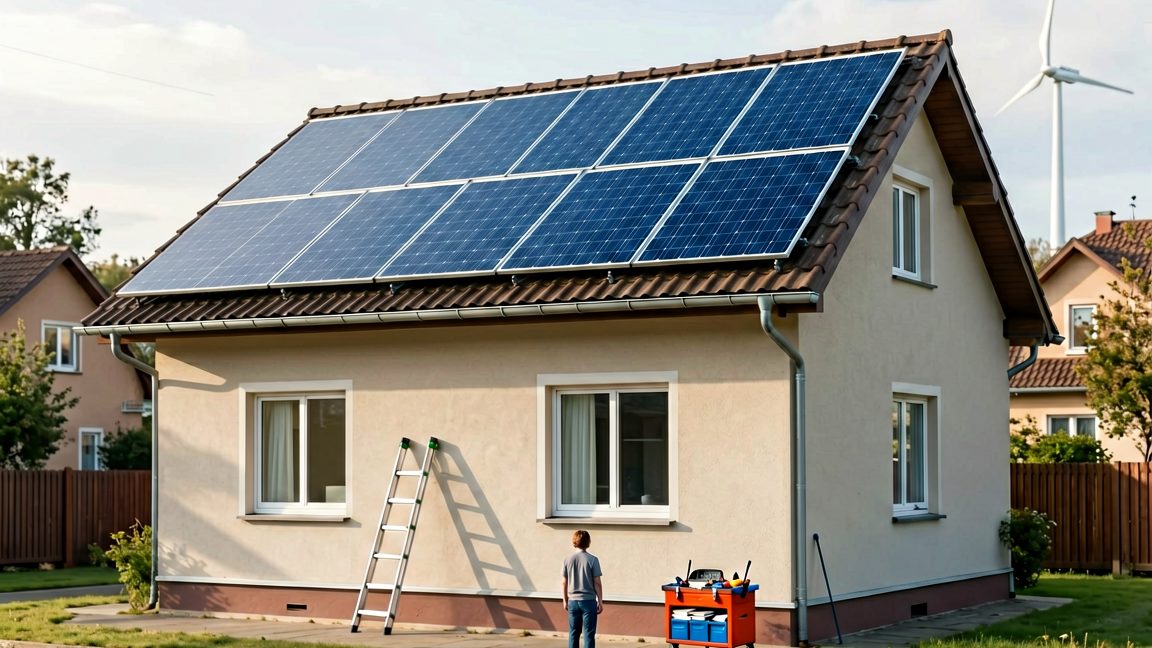
The German federal government's decision to discontinue the solar feed-in tariff from 2027 has already triggered a noticeable spike in residential photovoltaic (PV) orders.
Policy background
In 2024 the Bundesregierung announced, via an official press release, that the EEG-Vergütung, the feed-in tariff that guarantees a fixed price for solar electricity fed into the grid, will be phased out starting in 2027. The reform marks the end of a subsidy regime that has underpinned much of Germany's rooftop solar growth since the early 2000s.
Unlike a market-driven price, the feed-in tariff offered homeowners a predictable revenue stream for the electricity their panels generated. Its removal therefore eliminates a key financial incentive, prompting owners to reassess the economics of a new installation.
Market reaction
Spiegel Wirtschaft reported in September 2026 that demand for residential PV systems has risen sharply as owners try to lock in the current subsidy before it disappears. The outlet described the development as a "noticeable increase in orders and enquiries for residential PV installations."
Industry observers, quoted by Spiegel Wirtschaft, confirm that installers are fielding more enquiries than in the previous twelve months. The surge is not limited to a few regions; installers across the country report a higher volume of booking requests for the coming months.
Timeline of the policy shift
| Year | Event |
|---|---|
| 2024 | Government decides to end the solar feed-in tariff by 2027 (Bundesregierung press release). |
| Early-2026 | Policy details become public, prompting market anticipation. |
| September 2026 | Spiegel Wirtschaft notes a surge in PV-system demand. |
The 2024 decision set a three-year horizon for the phase-out. Early-2026 saw the government publish detailed reform parameters, which gave installers and suppliers a clearer picture of the timeline. Within months, the market response was evident, culminating in the September 2026 report of heightened demand.
Who stands to gain, and who may lose
Homeowners are the most immediate beneficiaries of the pre-emptive rush. By installing before the tariff ends, they can still claim the guaranteed feed-in price for the electricity their panels produce, improving the return on investment.
Solar installers and PV manufacturers are also seeing a short-term boost. The surge in orders translates into higher booking volumes, which can help smooth out production schedules that have been volatile in recent years.
Conversely, the phase-out could disadvantage late adopters. Once the tariff disappears, new installations will have to rely on market electricity prices and self-consumption savings, which are less predictable.
Implications for the German energy transition
Germany's renewable-energy targets remain ambitious, and residential solar is a key pillar of the strategy. The current rush may help bridge part of the capacity gap that the tariff removal could create.
However, analysts caution that a one-off spike does not guarantee sustained growth. If the subsidy gap is not filled by other incentives, the market could flatten once the initial wave of installations is completed.
What comes next?
Stakeholders will be watching order books closely throughout 2027. The government has not indicated any replacement mechanism for the feed-in tariff, so the pressure on homeowners to act before the deadline is likely to remain high.
Industry bodies plan to publish quarterly updates on installation volumes, which will provide a clearer picture of whether the early-2026 surge translates into lasting momentum. For now, the combination of a clear policy deadline and a finite window of financial benefit is driving a pronounced market reaction.