
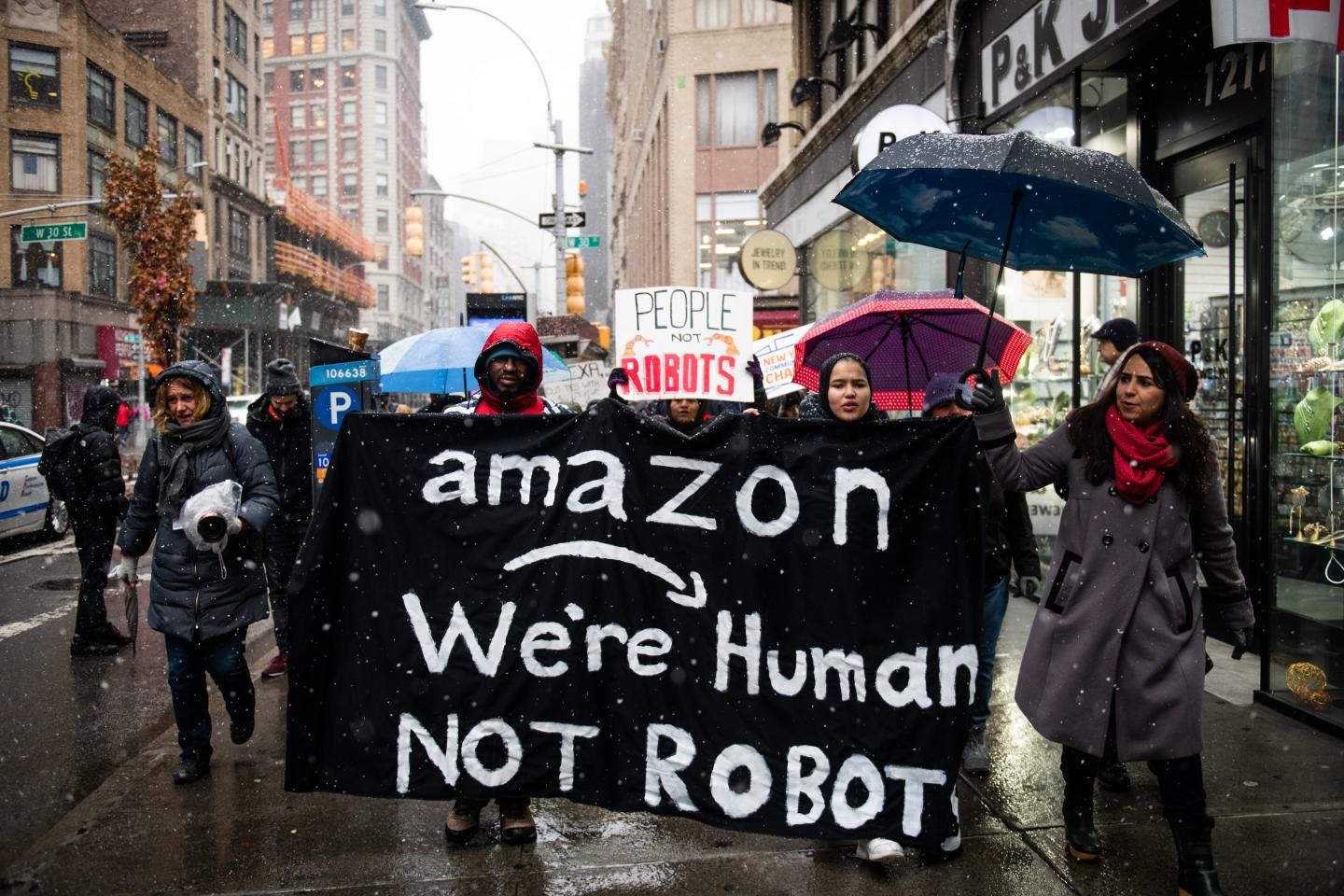
Amazon has seen the number of its staff on the Supplemental Nutrition Assistance Program (SNAP) and Medicaid rise sharply, according to a recent Government Accountability Office (GAO) study. The report counted 12,346 Amazon workers on SNAP and 11,338 on Medicaid across eleven states, figures that are nearly three times higher than in 2020. During the same period the retailer's annual profit climbed from $11.6 billion to $77.7 billion and its revenue reached a record $717 billion.
Why the surge matters
The growth in federal assistance use comes at a time when the United States' labour share, the proportion of economic output that goes to workers, has fallen to its lowest level since the Bureau of Labour Statistics began tracking the metric in 1947. Workers now receive just 52.8 percent of total output, while corporate profits have risen sharply, with the S&P 500 gaining about 600 percent since 2000 and wages increasing only 12.5 percent after inflation adjustment.
Rachael Lighty, a spokesperson for Amazon, argued that the raw numbers are misleading, pointing out that the company offers health coverage from day one and that 74 percent of its regular full-time staff are enrolled in an Amazon health plan, well above the private-sector average of 65 percent. Nevertheless, analysts say the data highlights a broader trend of workers earning less even as they remain employed full-time.
Broader context and expert views
Katherine Larin, director for education, workforce and income security at the GAO, explained that many of the people receiving SNAP are full-time employees whose earnings are still below the eligibility threshold of about 130 percent of the poverty line. Diane Swonk, chief economist at KPMG, warned that a shrinking labour share can fuel social and economic instability, noting that corporate profits as a share of GDP have risen from 8 percent to 15.85 percent since 1982 while employee compensation fell from 66.6 percent to 61.9 percent of GDP.
Academic research links the trend to changes in employment structures and technology. Anna Stansbury, an assistant professor at the MIT Sloan School of Management, highlighted the decline in union coverage, from 20.1 percent in 1983 to 10.0 percent in 2025, and the rise of subcontracted and gig work that reduces employers' obligations to provide benefits. Brent Neiman of the University of Chicago attributes part of the wage pressure to artificial intelligence, arguing that productivity gains from AI are often used to raise prices rather than wages.
In a white paper, Torsten Slok of Apollo and economist Sania Edlich found that occupations with high AI exposure saw a 6.7 percent decline in real wage growth after 2023, even though employment levels remained stable.
What could happen next
Experts differ on whether the decline in labour share is a temporary cycle or a longer-term shift. Stansbury suggests that if inflation eases and the labour market stays tight, wages could recover and the share might stabilise. Conversely, if wage growth remains weak despite a strong job market, the trend could become entrenched, signalling a deeper structural change in the US economy.
Policymakers and companies will face pressure to address the gap between soaring corporate earnings and the living standards of their workforce, especially as more workers rely on public assistance while remaining fully employed.