
The belief that the United States became a democratic superpower because of some unique national character remains a central article of faith in American civic life. Christians see divine providence, Enlightenment admirers credit the Founding Fathers, and sociologists point to a distinctive talent for voluntary association. A wider historical lens suggests a more prosaic driver: the sheer abundance of land.
The Feudal Engine of Medieval Europe
The story begins with the collapse of the Roman Empire. Germanic warlords who carved kingdoms from the wreckage lacked the bureaucracy to tax effectively or maintain standing armies. They paid volunteer soldiers with plunder and, crucially, with land. This exchange created the military order of feudalism. A king's power rested on the military might of his vassals, who in turn attracted lesser vassals with grants of conquered territory.
This system contained a fatal structural flaw. Every fief granted made a vassal stronger and more independent, turning each into a potential rival. The king could only secure his throne by conquering new lands to distribute, which only multiplied the threat in the long run. Endless war became the default state of politics.
Charlemagne's Legacy and the Push Eastward
The core of feudal Europe was the region conquered by Charlemagne in the ninth century, stretching from the Pyrenees to Bohemia and from the Baltic to northern Italy. As competition in this crowded core intensified, ambition shifted to the sparsely populated lands of the north and east. Rulers there needed settlers, not just peasants but artisans to forge armour, build castles and operate siege engines. Towns became indispensable to royal security.
To attract colonists, rulers offered enhanced property rights and civil autonomy. The 12th-century charter of Dublin let residents administer their own affairs, form guilds and build freely. Legal templates spread rapidly across the continent, creating a transnational network of rights for urban inhabitants known as burgesses or the bourgeoisie.
Towns, Trade and the Rise of the Bourgeoisie
New riverine and overland trade routes criss-crossed Europe as kingdoms expanded. Trade generated wealth that kings could tax. These revenues, combined with developing bureaucracies, began to resolve the ancient conflict between lords and vassals. Monarchs could now pay mercenaries instead of granting land for military service. The Hundred Years' War was fought largely by mercenaries, and at its end Charles VII created the first European standing army since Rome by bringing private military companies under direct royal command.
Over time, to use Max Weber's terminology, the crown monopolised the legitimate use of violence. Royal domains were pacified internally and warfare became a matter of conflict between great kingdoms. Something resembling the modern nation-state emerged. Pacification boosted trade and the chartered townships prospered, but the old feudal class structures did not vanish. Warrior knights became courtiers, retaining control of land without military function. Peasants and lesser aristocrats found themselves socially immobile, setting the stage for class conflict between the absolutist crown and the republican-minded bourgeoisie.
The Scots-Irish and the American Frontier
For discontented burgesses, farmers and lords without prospects, the American colonies offered an escape. Arable land was available to anyone willing to clear forests and face the threat of massacre by indigenous peoples. Here, the republican values incubated in medieval European towns could spread unencumbered by aristocratic dead weight.
Consider the Scots-Irish, Presbyterian transplants from Scotland to Ulster recruited by Queen Elizabeth I to displace the native Catholic Irish. They fled Scotland's poor conditions for better Irish land, only to find themselves under absentee English landlords who doubled and tripled rents once improvements were made. Feudalism had passed, but the labouring classes were still squeezed by nobles.
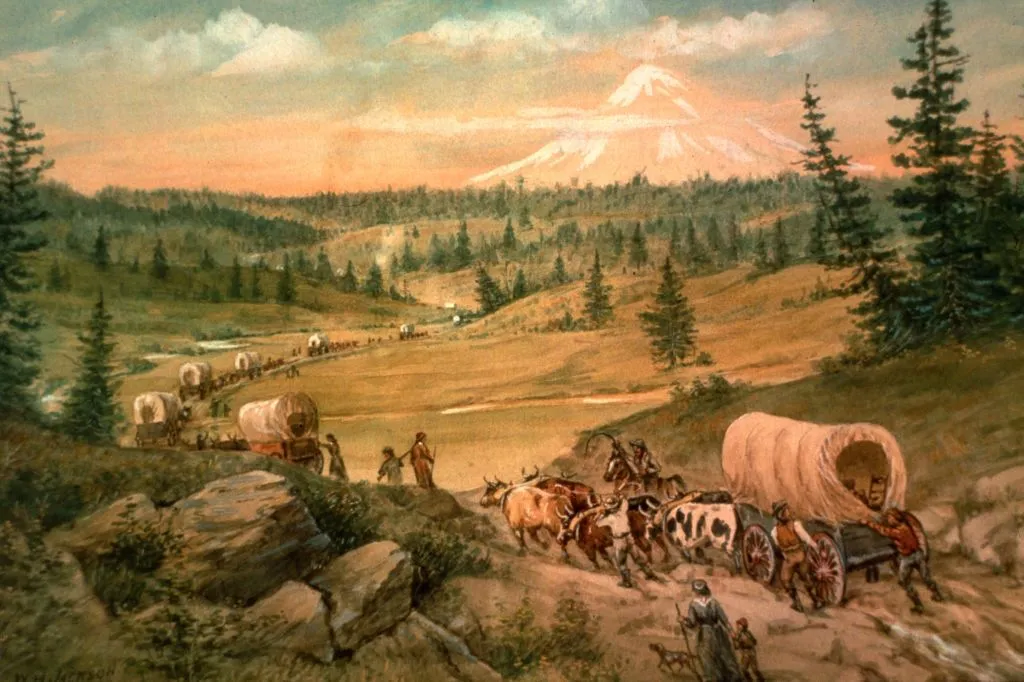
In the 18th century the Scots-Irish fled Ulster for Philadelphia, then pushed into the Appalachians. After independence they became the tip of the spear of American expansionism. The conquest of western North America required a different warfare than medieval Europe. Indigenous tribes had no stone castles or trebuchets. Settlers could take land without fielding armies of tens of thousands or reordering society to produce a warrior class and a servile population. They fought themselves, furnished their own weapons, and believed in liberty and natural rights rather than feudal oaths. This colonisation was entirely compatible with the old republican values of the European bourgeoisie.
Land Abundance and Republican Values
After the West was settled, the bourgeois ideology continued to prosper. Just as medieval warlords on Europe's peripheries needed settlers to secure power, the United States had a bottomless appetite for labourers, skilled workers, professionals and entrepreneurs to develop a conquered continent. It was a buyers' market for labour. The US government attracted migrants with economic opportunity and political liberties denied at home. With the colossal exception of enslaved Black people in the South, ruled by vestiges of European aristocracy only subdued by the Civil War and the Civil Rights Movement, American democracy flourished under these material conditions through the 20th century as economic growth increased the bargaining power of workers and entrepreneurs with the state.
The End of the Land Era
Those conditions have now vanished. In an age of urbanisation and industrialised farming, land is no longer a productive source of wealth at the household level. Far from coaxing migrants to develop a booming economy, the United States restricts entry to prevent competition for scarce jobs. With artificial intelligence rapidly displacing cognitive labour, the incentive for governments to grant new civil liberties to secure economic participation is disappearing. Humans are losing leverage over the institutions that rule them as their labour becomes cheap and superfluous.
At 250 years old, the United States has long ceased to be exceptional. There is reason to question whether its republican spirit will persist. Far too much emphasis rests on vague notions of a unique American commitment to freedom, and far too little on the material conditions that historically made democracy possible: abundant land without a landed gentry. Without these conditions, democracy persists merely as a matter of inertia. We should be cautious not to assume it will last.