
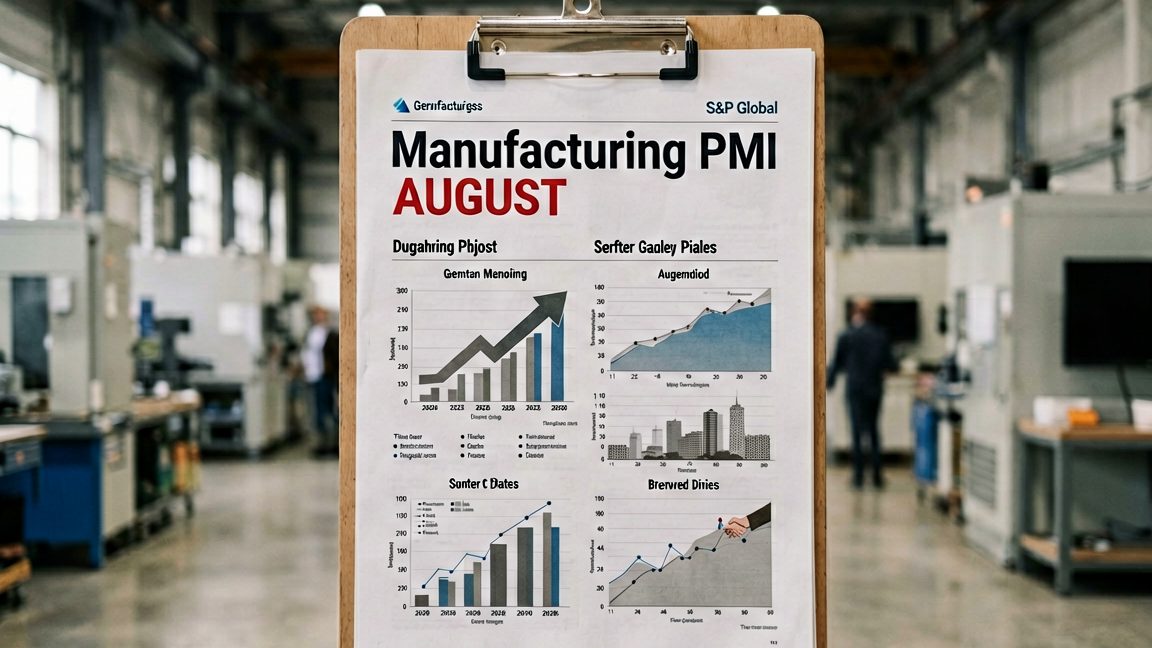
German manufacturing PMI rose to 54.1 in August 2026, the strongest reading since early 2022 and a clear departure from analysts' forecast of a modest decline.
What the PMI tells us
The Purchasing Managers' Index is compiled by S&P Global each month from surveys of purchasing managers across German industry and services. A reading above the 50-point threshold signals expansion, while a figure below 50 indicates contraction. The August 2026 figure of 54.1 therefore confirms that the sector is growing.
Tagesschau reported the number on 21 August 2026, citing the S&P Global survey. The methodology behind the index is outlined by S&P Global itself, which explains that the composite score reflects three sub-components, new orders, production and employment, each weighted according to its impact on overall activity.
Why the August reading matters
At 54.1, the index is the highest since early 2022, when German manufacturing briefly peaked in the mid-50s. Between 2022 and 2025 the PMI generally lingered below the 50-point growth line, signalling a prolonged period of contraction. The new figure therefore marks the first time in roughly four years that the sector has returned to a robust expansionary stance.
The rise reflects stronger production, an uptick in new orders and a rebound in exports, according to the survey's breakdown. Those three pillars are the traditional drivers of German industrial performance and, when they move in concert, they tend to lift broader economic confidence.
Unexpected surge, analysts missed the turn
Forecasters had predicted a slight decline for August, expecting the PMI to edge lower as supply-chain pressures persisted. The actual jump to 54.1 therefore caught the market off-guard. Tagesschau highlighted the contrast, noting that the surprise underscores the difficulty of modelling sentiment in a sector still adjusting to post-pandemic realities.
Analysts' mis-read may stem from two external factors that were expected to weigh on output. First, low water levels in the Rhine have constrained inland freight capacity, a bottleneck that traditionally drags on manufacturing logistics. Second, uncertainty in the Persian Gulf, where geopolitical tensions have threatened oil supplies, was thought to dampen export demand. Yet the PMI data suggest that manufacturers have managed to offset these headwinds, at least for the month.
Implications for investors and policymakers
For investors, the August reading offers a fresh data point that could reshape expectations about German industrial earnings. A PMI above 54 typically correlates with higher capacity utilisation and better profit margins, which may prompt equity analysts to upgrade forecasts for leading manufacturers.
Policymakers, particularly the European Central Bank, monitor PMI trends as an early-warning indicator of inflationary pressure. A sustained series of readings above 54 could signal that demand is picking up faster than supply, potentially nudging the ECB toward a tighter monetary stance sooner than planned.
On the national level, the German Ministry for Economic Affairs may view the figure as validation of recent industrial policy measures aimed at stabilising energy costs and supporting export markets. The data could also influence decisions on infrastructure investment, especially regarding the Rhine's water-level management, given that the PMI rose despite the bottleneck.
From early-2022 peak to today's rebound, a timeline
| Period | PMI reading | Context |
|---|---|---|
| Early 2022 | mid-50s (≈54-55) | Peak before a prolonged slowdown |
| 2022-2025 | below 50 | Sector in contraction, affected by supply-chain strains |
| 21 August 2026 | 54.1 | Highest since early 2022; unexpected rise |
The table, compiled from Tagesschau's report and S&P Global's methodology, illustrates how the sector moved from contraction back into expansion within a single month.
Who is watching the data?
Beyond investors and central bankers, the PMI is a key reference for German trade unions, which use the index to gauge labour market health. A reading of 54.1 suggests that hiring pressure may ease, potentially influencing wage negotiations slated for later in the year.
Export-oriented firms, especially in the automotive and machinery sectors, will also track the index closely. The PMI's indication of stronger new orders could translate into higher order books, prompting firms to accelerate capital spending on automation and digitalisation.
What comes next?
The next PMI release, scheduled for September 2026, will reveal whether August's surge is a one-off blip or the start of a sustained upturn. Analysts will be looking for consistency across the three sub-components, production, new orders and employment, to assess the durability of the rebound.
Meanwhile, policymakers are likely to weigh the data against other indicators, such as industrial output and trade balances, before adjusting fiscal or monetary levers. If the upward trend continues, Germany could see a modest lift in industrial growth rates for the remainder of the year, offering a counterweight to the broader eurozone slowdown.
In short, the August 2026 PMI provides fresh evidence that German manufacturing is rebounding, even as water-level constraints and geopolitical uncertainty linger. The sector's performance in the coming months will determine whether this signal translates into lasting momentum for the German economy.