
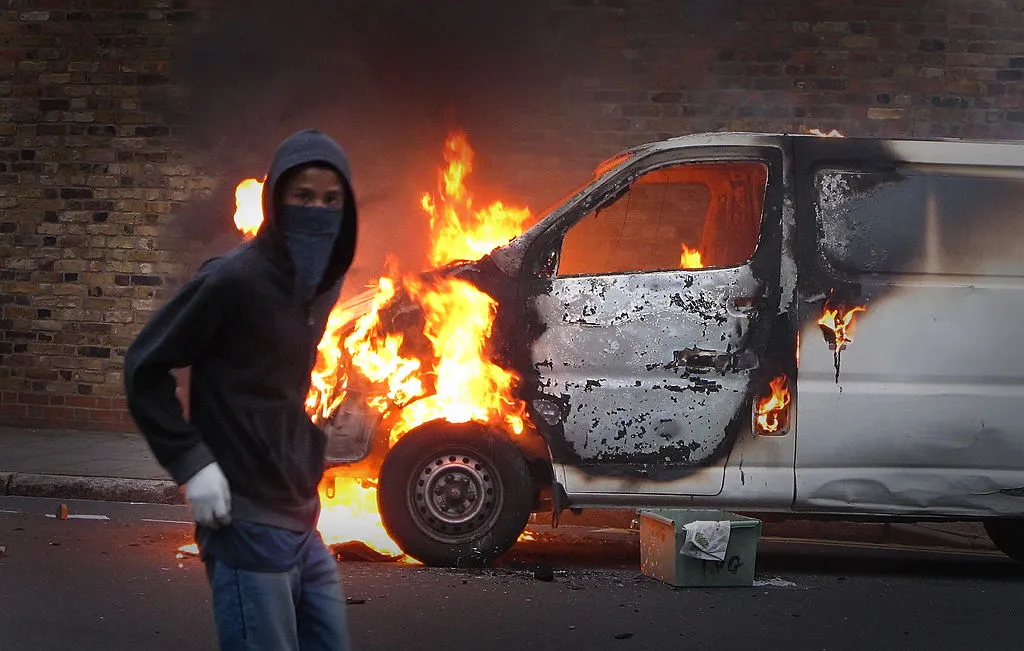
Fifteen years after the London riots of 2011, Britain confronts a quieter but pervasive breakdown of everyday order. The unrest that began in Tottenham after the police shooting of Mark Duggan exposed how quickly urban centres could descend into looting and violence. Today the spectacle has shifted from mass rioting to a steady rise in fuel theft, shoplifting, mobile phone snatching, fly-tipping and fare-dodging that together suggest a society where basic norms are no longer self-enforcing.
Fuel theft surges after Iran war price shock
A recent analysis by security firm Forecourt Eye found that in the five months since the Iran war began, British forecourts have lost £200,000 worth of petrol and diesel every day, a figure almost 50 per cent higher than before the crisis. Station owners report that thieves are no longer only organised gangs filling jerry cans for resale. Birmingham operators told The Guardian that ordinary motorists, some saying they simply cannot afford to pay, now drive off in plain sight. "It could be anyone," one owner said. "They come right in front of you, because they have no fear."
Premiership of Andy Burnham fails to arrest decline
Three weeks into Andy Burnham's premiership, the surface mood may feel steadier. Labour's populist challengers are fading in the polls and the small boats crisis has dropped down the agenda. Yet the underlying currents are moving in the opposite direction. The spread of low-level criminality points to a low-trust environment where a failure to observe basic rules turns daily life into a gauntlet. It also damages faith in the state, which citizens blame both for the unaffordability of essentials and for the failure to enforce its own laws.
Global shocks feed resource-related crime
The petrol-pump raids are part of a wider pattern of resource-related criminality driven by global disorder. In 2024 Italian authorities intercepted almost $1 million worth of counterfeit olive oil, debased with chlorophyll and already circulating in dozens of Roman restaurants, a trade spawned by crop failures linked to climate change. Rising copper prices, pushed up by technological demand, have triggered a surge in cable stripping on the UK rail network, where more than 100 thefts last year caused 130,000 minutes of delays. Spikes in the gold price, driven by investors seeking safe havens, have fuelled illegal mining from Ghana to the Amazon.
History shows crime not simply tied to poverty
These trends might suggest economic pressure alone drives crime, but history complicates that picture. In the 1930s and 1940s the average Briton was far poorer than today, yet the prison population of England and Wales hovered around 10,000 compared with over 85,000 now. Crime doubled during the 1970s downturn but also doubled during the 1960s boom. Since the turn of the century most offence categories have fallen again despite recurring economic stress.
Study of 2011 rioters reveals mixed motives
A study of 1,620 people arrested during the 2011 riots found that neighbourhoods with high arrest rates correlated with resentment towards police, poverty and ethnic diversity. Researchers suggested diverse areas may be less cohesive, reducing adults' ability to restrain youth. The current rise in fuel theft and the post-Covid shoplifting boom point to a similar cocktail of material and social causes.
Concept of social crime explains moral disengagement
Criminologist Clive Emsley described "social crime" as an illegal act that communities do not regard as truly criminal, or that is seen as justified protest. In 19th-century Manchester residents routinely took water from outdoor taps without paying the water company. In the 18th century smuggling won public sympathy when it evaded the hated tea duty. A Norfolk man sentenced for shooting livestock in 1839 told the court that the poor had been driven to a state where honest living was impossible, all to support "big-gutted relieving officers". He was transported to Australia.
Modern rationalisations mirror historic patterns
Today various thefts are acquiring that social crime character. Perpetrators do not believe they are doing wrong, or sense their peers will not judge them harshly. Economic pressure makes the justifying narratives more compelling. A shoplifter facing rising prices may feel stealing from a supermarket only hurts greedy shareholders. A self-employed worker paid off the books may reason that corporations avoid tax anyway.
"The rich don't play by the rules. So why should I?"
That sentiment headlined a New York Times discussion in April featuring commentators Jia Tolentino and Hasan Piker. Piker declared himself "pro stealing from big corporations". Tolentino added that when she took goods from Whole Foods, a practice dubbed "microlooting", she was buying groceries for a mutual-aid group.
Cynicism undermines public realm
Such reasoning, however understandable, corrodes the mutual decency on which public life depends. The government itself has fed the cynicism by attacking supermarkets and petrol stations over prices, even though tax constitutes a far larger share of fuel costs than forecourt profits. The populist right is no more consistent. Reform UK campaigns on "Lawless Britain" yet its own financial controversies weaken any moral authority to demand rule-following.
Policing and compassion both fall short
Neither a "broken windows" crackdown nor a purely compassionate approach will solve the problem. Paltry penalties and absent enforcement have indeed encouraged rampant theft of bikes, phones and diesel. But relying on harsher state power risks a future where pervasive surveillance merely masks the evaporation of genuine authority. Treating crime solely as victimhood expression will not dent the growing belief that some law-breaking is morally justified or politically virtuous.
Moral dimension requires civic renewal
Economic stress, scarcity, lost cohesion and fading trust are all part of the problem. There is also a moral dimension that demands a moral response. Historian Robert Tombs notes that Victorian campaigns against anti-social behaviour succeeded because politicians, churches, charities, trade unions, schools, police and ordinary neighbours cooperated. Those institutions hold far less sway today, and social media offers few wholesome role models.
Future shocks will test fragile solidarity
Politically, the question is how Britain would cope if further global shocks bring shortages and price spikes. There are reasons for optimism: the pandemic showed acquiescence to authoritarian measures, price caps remain popular, and egalitarian welfare principles retain broad support. One can imagine daily updates from a sober but sensitive Prime Minister Burnham.
Yet the rise of casual crimes like fuel theft asks whether the reserves of solidarity leaders invoke still exist. The heavier the sacrifice demanded, the more free-riding will shred trust in society and the state. Let us hope we never have to discover how fragile the equilibrium really is.