
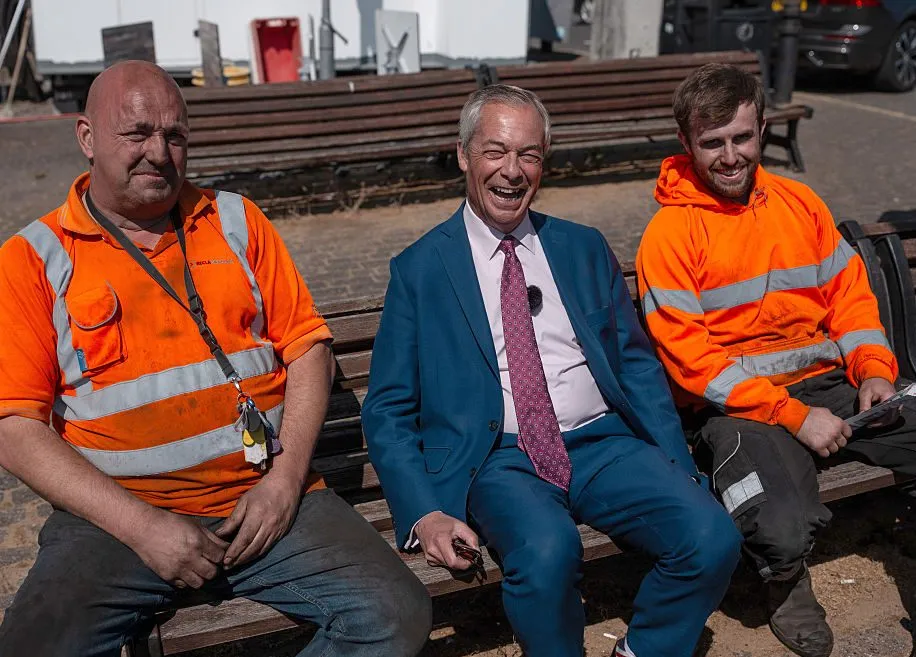
Nigel Farage and Rupert Lowe embody two distinct strands of right-wing politics now vying for dominance across the South East. The Reform UK leader presents himself as a Kentish wheeler-dealer shaped by the London periphery. His rival, the Restore party founder, has reinvented himself as a farmer in wellies defending rural grievances. Their rivalry, and a possible electoral pact, will shape the right's offer to voters at the next general election.
Kentish roots and the London periphery
Farage grew up in Downe, a Bromley village absorbed into Greater London two days before his first birthday. He has never called himself a Londoner. The distinction matters: London is for making money; Kent, in his telling, is for fishing, family and freedom. That identity anchors his political persona, close enough to the capital to understand it, far enough to claim the provincial common folk.
Lowe, by contrast, cut his teeth in the City before pivoting to an agrarian pitch. Flanked by sheep and railing against metropolitan attacks on rural Britain, he claims the mantle of the Countryside Alliance. The contrast is stark: Farage the libertarian trader, Lowe the protectionist farmer.
A natural division of territory
Insiders suggest a Reform-Restore pact is probable if an early election is called. Restore would stand down in Kent and Essex, while Reform would cede Great Yarmouth and other rural seats to Lowe. The logic is geographic: Farage appeals to the Cockney diaspora spread across the Thames estuary; Lowe speaks to farmers and smallholders.
Farage's connection to Kent runs deep. He represented South East England in the European Parliament for 21 years. He hunted Westminster seats in Bexhill and Battle, Bromley and Chislehurst, and twice in South Thanet before winning Clacton in 2024. The Essex coastal seat mirrors his Kentish base, Reform-friendly, working-class, shaped by the same estuary culture.
Channel coastline and the politics of insularity
Kent is, paradoxically, the most European part of Britain. On a clear day Calais is visible from Dover. Ted Heath, the Kentish prime minister who took Britain into the European Community, saw a bridge. Farage sees proof of England's insularity. In 2016 Kent voted Leave by a wider margin than the national average.
The coastline also makes Kent a frontline. From the Armada to the Napoleonic invasion scare, the county has been England's watchtower. Farage was among the first to sound the alarm on small-boat crossings, tweeting in 2021 of "another huge armada" hitting Kent beaches. This week Reform announced it would deploy the Royal Navy to stop the boats.
Wat Tyler's legacy and the radical south-east
Political scientist Matthew Goodwin once compared Farage to Wat Tyler, the 1381 rebel claimed by both Kent and Essex. The Peasants' Revolt erupted here because proximity to London meant pressure could be applied to the centre. Norfolk peasants rose too, but distance blunted their impact. Lowe, the Norfolk MP, may discover the same limit: rural grievances struggle to impress the metropole unless they encircle it.
The 1381 rebels were loyalists demanding the king dismiss corrupt counsellors. They also attacked Flemish and Lombard merchants in London. The pattern persists: Kent and Essex look to London for salvation but reserve the right to set it right themselves. Tax resistance fuelled the revolt; six centuries later the same counties became Thatcherite heartlands.
Libertarian economics versus agrarian protectionism
Farage's political awakening came at 14 reading John Stuart Mill's On Liberty at Dulwich College. A visit from Sir Keith Joseph, Thatcher's libertarian guru, drew him into the Conservative Party. Asked in 2014 whether he belonged to the "small-c conservative family", he replied: "God no!" He identifies instead as a 19th-century liberal.
When Farage joined UKIP it was called the Anti-Federalist League, a deliberate echo of the Anti-Corn Law League that defeated the landed farming interest. In a 2013 conference speech he made the Cobdenite case for Brexit: leaving the EU would restore Britain's ability to strike free trade deals, including abolishing tariffs on African produce. Peace and prosperity through free trade, pure Manchester Liberalism.
Lowe's agrarian protectionism sits uneasily with that tradition. The Anti-Corn Law League broke the farmers as a political force; they never recovered. Lowe's attempt to revive them faces the same structural obstacle.
The Burnham factor and a southern strategy
Andy Burnham's mayoral victory in Greater Manchester, and his disavowal of Thatcherism, may have relieved Farage. Recent reports suggested Farage was flirting with Peter Shore's state-control economics to court the post-industrial North. Burnham's rise lets Farage revert to his southern, Thatcherite comfort zone.
Reform has quietly dropped its more interventionist posturing. The party-aligned Centre for a Better Britain, backed by John Redwood, now advocates supply-side reforms, spending cuts and a tax freeze, classic liberal economics. There is little room for Lowe's vision in that prospectus.
The emerging "southern strategy" would write off the North to Burnham's "Manchesterism". Instead Reform would offer the South a populist liberalism: popular sovereignty, suspicion of the state, hostility to taxation, border vigilance. Throw bones to Lowe's farmers without embracing full protection. Force the Conservatives into a merger. Then run the campaign Farage has always wanted, the kind that served Thatcher three times.
What happens next
A Reform-Restore pact remains the most likely near-term outcome. It would formalise a geographic division that already exists in practice. But the intellectual centre of gravity lies with Farage. His libertarian economics, rooted in Kentish and Essex history, align with the think-tank infrastructure now shaping Reform's platform. Lowe's agrarian revolt is real but structurally disadvantaged, just as the Corn Law League's opponents were. The next election will test whether a southern, free-trade populism can break the two-party mould, or whether the North's new political settlement under Burnham holds the line.