
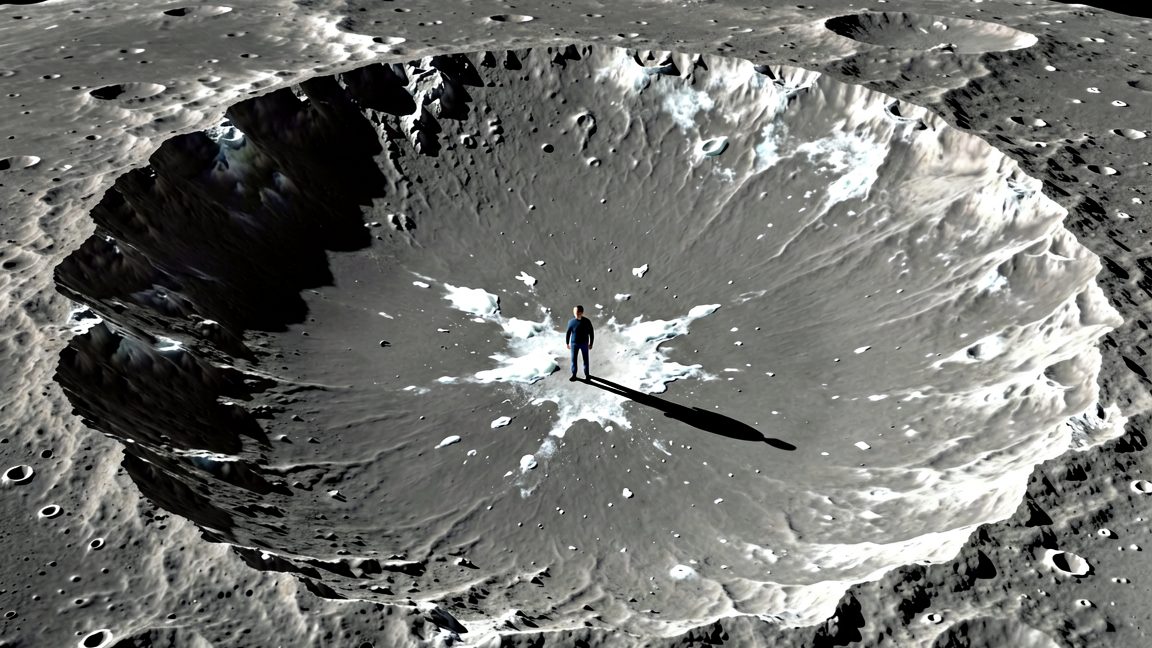
A new analysis by astrophysicists Martin Elvis and Jonathan McDowell finds that, even with an optimistic estimate of one billion tonnes of lunar water and ISS-level 98 % recycling, a lunar settlement of one million people would run out of water in roughly a century.
How the calculation was built
The Heise article of 14 September 2026 explains that the researchers based their model on three core inputs. First, remote-sensing data confirm the presence of frozen water in permanently shadowed lunar polar craters, providing the raw resource pool. Second, the analysis adopts the most optimistic water-mass estimate, about 1 billion t, which is roughly thirty times higher than the conservative baseline used in earlier studies. Third, the model assumes a water-recycling efficiency of 98 %, the recovery rate achieved by the International Space Station's life-support system.
By dividing the total water mass by the per-capita consumption implied by the ISS benchmark, the authors arrive at a depletion horizon of approximately 100 years for a settlement of one million inhabitants. The same arithmetic, applied to a community of up to 10 000 people, stretches the water horizon to several centuries.
| Parameter | Estimate | Period / Basis | Source |
|---|---|---|---|
| Estimated lunar water reserves (upper bound) | 1 billion t | Current estimate | Heise, Analyse: Wasser auf dem Mond würde für eine große Stadt nicht sehr lange reichen |
| Water recycling efficiency (ISS level) | 98 % | ISS operations | Heise, Analyse: Wasser auf dem Mond würde für eine große Stadt nicht sehr lange reichen |
| Depletion time for 1 million-person settlement | ≈100 years | Based on above assumptions | Heise, Analyse: Wasser auf dem Mond würde für eine große Stadt nicht sehr lange reichen |
| Sustainability horizon for ≤10 000-person settlement | Several centuries | Based on above assumptions | Heise, Analyse: Wasser auf dem Mond würde für eine große Stadt nicht sehr lange reichen |
What the numbers mean for different settlement sizes
At the heart of the analysis is a simple ratio: total water divided by the amount that can be reclaimed each year. With a 98 % recovery rate, the net loss per person is roughly 2 % of the water they consume. For a community of one million, that translates into an annual net draw of about 20 million tonnes, a figure that would exhaust the 1 billion-ton reserve in about 50 years if the loss were linear. The authors, however, incorporate realistic consumption patterns and arrive at a slightly longer horizon of roughly 100 years.
Scale matters dramatically. Reducing the population to 10 000 cuts the annual net draw to 200 000 t, extending the water supply to several hundred years. The analysis therefore draws a clear line: megacity-scale lunar habitats are water-limited on a generational timescale, whereas modest bases can be sustained for multiple centuries under the same recycling efficiency.
Implications for European lunar ambitions
Europe's space policy, articulated through ESA's lunar exploration programme, has repeatedly highlighted the need for sustainable life-support systems. While the Heise piece does not detail ESA's specific habitat targets, it notes that the findings are relevant for any agency planning long-term lunar outposts.
For European decision-makers, the water-budget constraint adds a quantitative dimension to the strategic debate. If the goal is to establish a permanent research hub for a few thousand scientists and engineers, a scale that aligns with the "few-thousand" figure mentioned in the analysis, the water supply appears adequate for centuries, provided ISS-level recycling can be replicated.
Conversely, proposals that envision a lunar city with a population approaching a million would need to confront a water turnover that outpaces even the most efficient closed-loop systems. The analysis suggests that, without breakthroughs in in-situ resource extraction or recycling beyond 98 %, such a megacity would face a water shortage within a human lifetime.
European industry, which includes contractors developing habitat modules, life-support hardware, and extraction technologies, will likely weigh these limits when drafting bids for ESA contracts. The water-budget numbers provide a concrete benchmark against which new technologies, for example, advanced electro-lysis or cryogenic storage, can be evaluated.
Private-sector considerations: Blue Origin, SpaceX and beyond
American firms such as Blue Origin and SpaceX have publicly discussed lunar settlement concepts that range from small research outposts to larger commercial habitats. While the Heise article does not cite their specific plans, the water-budget analysis offers a common reference point.
For a company aiming to host a tourist or industrial base of several thousand people, the "several centuries" horizon suggests that water scarcity would not be an immediate blocker, assuming they can match ISS recycling performance. However, any ambition to scale up to a million-person lunar city would confront the same 100-year limit identified by Elvis and McDowell.
These constraints could shape investment decisions. Companies may prioritize technologies that increase water extraction from regolith or that push recycling efficiency above the ISS benchmark. The analysis implicitly rewards such innovation, because each percentage point gain in recovery would proportionally extend the lifespan of larger settlements.
Looking ahead: policy, research and technology pathways
The next steps for European stakeholders will likely involve three parallel tracks. First, further remote-sensing missions, such as ESA's upcoming lunar polar orbiter, can refine the upper-bound water estimate, reducing the uncertainty around the 1 billion-ton figure.
Second, ground-based testing of closed-loop life-support systems will aim to exceed the 98 % recovery rate demonstrated on the ISS. Even modest improvements would lengthen the viable horizon for larger habitats.
Third, policy discussions within ESA and the broader EU space community will need to integrate the water-budget data into long-term planning documents. While the Heise analysis does not prescribe a specific policy response, it provides a quantitative anchor for debates about settlement size, timeline, and the allocation of research funding.
In the meantime, private actors are expected to continue publishing concept studies that reference the same ISS recycling benchmark. As those studies emerge, the lunar-water budget will remain a key metric for assessing feasibility.
the Elvis-McDowell analysis reminds European planners that the Moon's water resource, even at its most generous estimate, imposes hard limits on how many people can live there sustainably. The challenge now is to align technology development, policy frameworks and commercial ambition with those limits.