
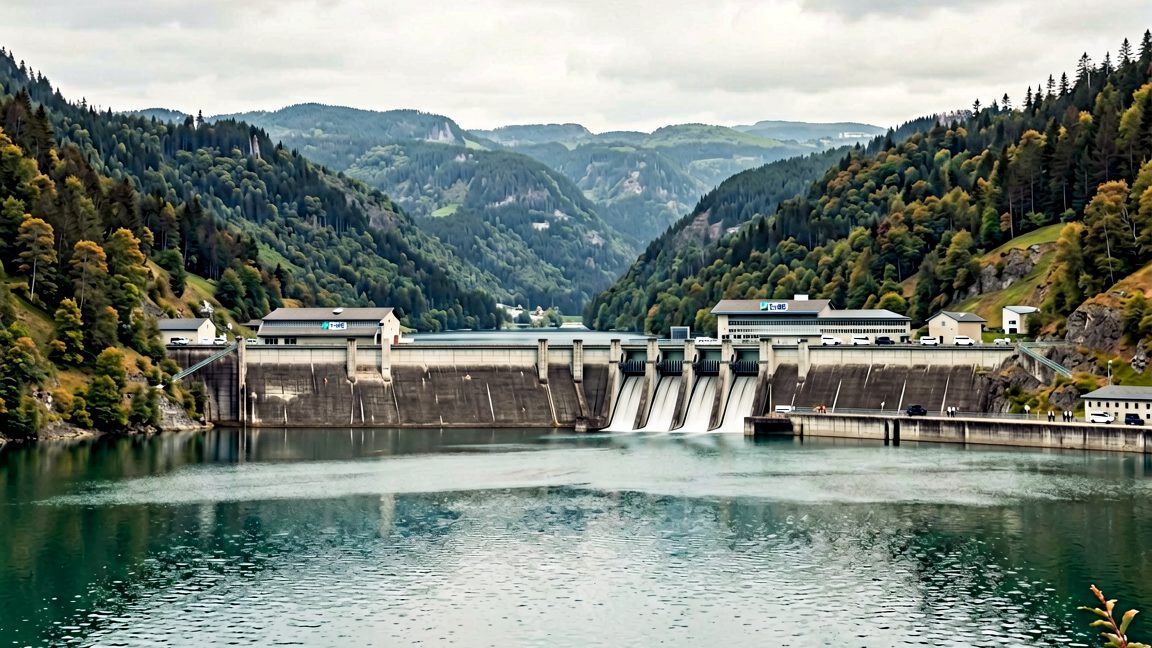
Schluchseewerk will invest more than €1 bn over the 2026-2036 period to raise pumped-storage generation capacity and enlarge the Schluchsee reservoir, the operator confirmed in a statement reported by taz.
Scope of the upgrade
The programme lifts the output of the Säckingen plant from 360 MW to 387 MW and the Wehr plant from 910 MW to 980 MW, delivering a net increase of at least 97 MW. These figures come from the operator's own statements, as covered by taz.
A new 106 MW reversible turbine unit will be built at the Häuser site. It will be the first reversible pump-turbine in Schluchseewerk's fleet, marking a technical first for the company.
In parallel, the Schluchsee reservoir will be enlarged so that its usable storage capacity reaches up to 91 GWh. The expansion is part of the same ten-year plan and is also sourced to taz.
| Label | Value | Period | Source |
|---|---|---|---|
| Total investment | >€1 bn | 2026-2036 | taz |
| Additional generation capacity | 97 MW | 2026-2036 | taz |
| New reversible unit at Häuser | 106 MW | 2026-2036 | taz |
| Target reservoir storage | 91 GWh | 2026-2036 | taz |
Why the upgrade matters
Germany's electricity system is increasingly powered by wind and solar, which generate electricity intermittently. Fast-acting, large-scale storage such as pumped-hydro can absorb excess generation and release it within minutes, providing the flexibility that the grid needs to balance supply and demand.
By adding reversible turbine technology and expanding reservoir capacity, Schluchseewerk positions itself as a key provider of that flexibility. The upgrade covers all five of the company's Black-Forest sites, making it the biggest modernisation effort in its near-century history.
Implementation timeline
The programme was publicly announced in 2026. Over the following decade, capacity upgrades at Säckingen and Wehr, construction of the Häuser reversible unit, and the reservoir expansion will be carried out in phases, as outlined by the operator and reported by taz.
What comes next
Schluchseewerk will now move to detailed engineering and procurement for the reversible unit, while regulators monitor the impact on grid stability. The success of the upgrades could shape future investment decisions in pumped-storage across Germany's renewable-energy transition.