
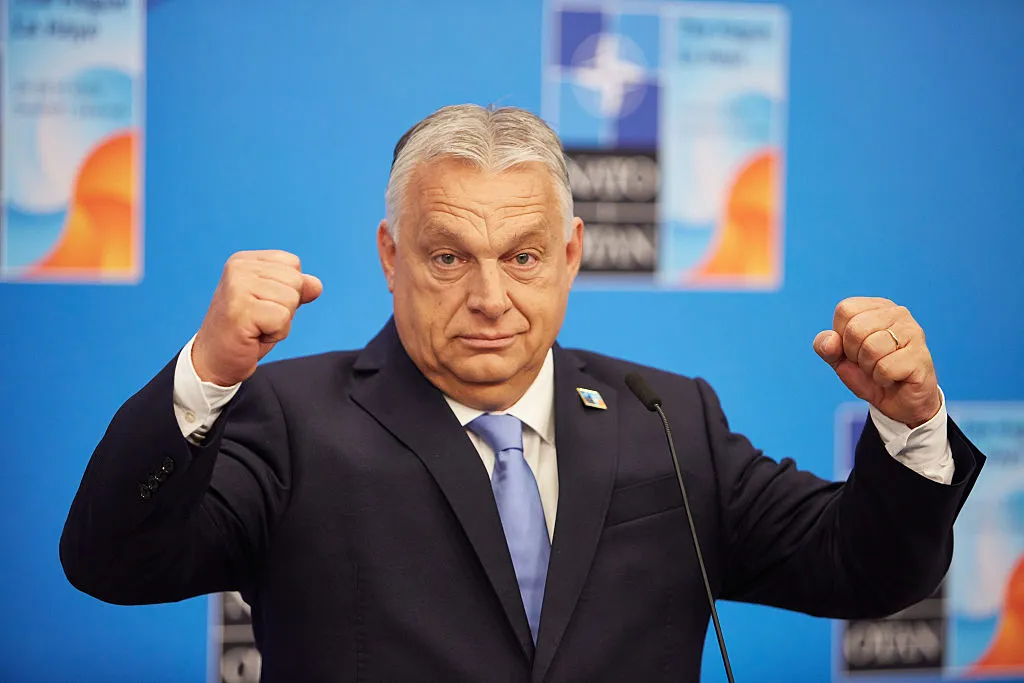
On 15 March, an estimated 100,000 supporters of Hungary's governing Fidesz party filled the boulevards and bridges of Budapest for the country's national day. Billed as a peace march against deeper involvement in the Ukraine war, the rally doubled as a show of force for Viktor Orbán as he faces the most serious challenge of his 16-year rule from Péter Magyar and the upstart Tisza Party.
A campaign turned toxic
The final weeks of campaigning have taken an unusually dark turn. Both sides now trade accusations of foreign intelligence manipulation, with competing leaks of wiretaps, arrests and espionage claims dominating the news cycle. Even independent commentators such as former Green Party leader András Schiffer allege that British, French, German, Polish and Baltic security services are meddling, while opposition-aligned journalists point to Russian interference and potential false-flag operations.
Since the war seems like a stalemate from a Hungarian perspective, and it hasn't moved that much in Hungary's direction, the recent effort has been to portray Ukraine as an active threat.
The speaker is Gábor Győri, a political analyst at the progressive Policy Solutions think tank. He describes the focus on Ukraine as a tried-and-tested Fidesz tactic. With the opposition's strength rooted in Hungary's faltering economy, an external enemy serves a clear electoral purpose. Previous villains have included transnational migrants and their NGO backers, Brussels, and the international LGBT movement. Now it is Kyiv's turn.
From condemnation to confrontation
Hungary's trajectory has shifted dramatically since February 2022. Initially, Budapest condemned the Russian invasion, sent humanitarian aid and opened its borders to Ukrainian refugees, despite Orbán's warm ties to Vladimir Putin. Over time the narrative moved to claims that Russia was provoked, and now to the assertion that Ukraine itself is the aggressor and a direct threat to Hungarian security.
In liberal districts of the capital, posters linking Magyar to Zelensky are routinely torn down or defaced with stickers reading "Vile, Deceitful Propaganda" or "Dirty Fidesz". At the peace march, however, the message resonated. Behind a banner declaring "We will not become a Ukrainian colony!" the crowd booed Zelensky's name when Foreign Minister Péter Szijjártó denounced the "Ukromafia". One attendee, Marco, 42, said: "Viktor Orbán is one of the few in politics who is proud to be Hungarian. But Tisza and Péter Magyar, I think he will make steps outside of Hungary, maybe in Brussels against his own country, and this I think is not correct."
Kyiv's own missteps
The Ukrainian government bears some responsibility for the deterioration. Its demanding diplomatic style has alienated several European allies. The European Union sided with Hungary and Slovakia in a dispute over Ukraine's closure of the Druzhba pipeline, which supplies cheap Russian oil both countries depend on. When Zelensky appeared to threaten Orbán directly, he earned a rare public rebuke from Brussels. Hungary has since used its veto to block EU funding vital to Kyiv, while Hungarian intelligence arrested Ukrainian officers transporting cash across Hungary for purposes heavily implied to be nefarious.
Kyiv responded by arresting a Hungarian accused of running a spy network in Zakarpattia oblast, home to a Hungarian minority and a long-standing irritant in bilateral relations. Neither Tisza nor the Ukrainian foreign ministry agreed to interview requests for this article. The Hungarian government, by contrast, offered unusual access to senior figures.
Three red lines
Péter Sztáray, State Secretary for Security Policy and Energy Security, framed a Tisza victory as a risk to Hungary's energy security and neutrality. "We [would] have to let through weapon deliveries through the Hungarian-Ukrainian border while, at the same time, Ukraine is closing our energy supply, Ukraine is shrinking the rights of the national minority communities, including the Hungarian community. So why should we do that? And their political messaging is very insulting at the same time."
A few days after the march, Balázs Orbán, the prime minister's strategic adviser and campaign manager, outlined three irreconcilable differences. First, active financial and logistical support for the war against Russia. Second, EU membership for Ukraine, which he argued would drag Hungary into the conflict and turn Budapest into a net contributor. Third, Russian energy, which he said Hungary cannot reject while the Middle East destabilises and prices surge. "These are just black and white issues," he said. "So either we give it up and we surrender, or we keep our positions."
Opposition mirrors government on key points
Despite being portrayed as zealous pro-Kyiv radicals, Magyar has largely avoided discussing the war. A former Fidesz functionary and conservative nationalist, he opposes sending weapons to Ukraine, insists Kyiv's EU bid should face a Hungarian referendum it would likely lose, and says weaning Hungary off Russian energy would take at least a decade. Hopes in Brussels or Kyiv of a post-election pivot appear unlikely to survive Magyar's own inclinations, let alone broader voter scepticism.
A paranoid climax
Four years ago, the invasion helped Orbán secure victory by framing his steady governance as the safest choice in volatile times. That script is being replayed, but the rhetoric has escalated sharply. Ukraine is now presented as a direct threat to Hungarian sovereignty. Both sides accuse the other of deep entanglement with hostile foreign intelligence services.
It is confusing and exhausting for foreign observers, and doubly so for Hungarian voters. Some 79 per cent believe foreign agencies will attempt to meddle. On Easter Sunday, the Hungarian government, alongside ally Serbia, announced it had foiled a plot to sabotage the vital Turkstream gas pipeline with explosives. Magyar immediately dismissed the claim as a false flag designed to sway or delay the election.
As the campaign reaches its climax, the European Union's most consequential election of the year has adopted the murky, paranoid tone of a spy novel. Whatever the result on polling day, the damage to Hungary's relationship with its larger neighbour may prove lasting.