
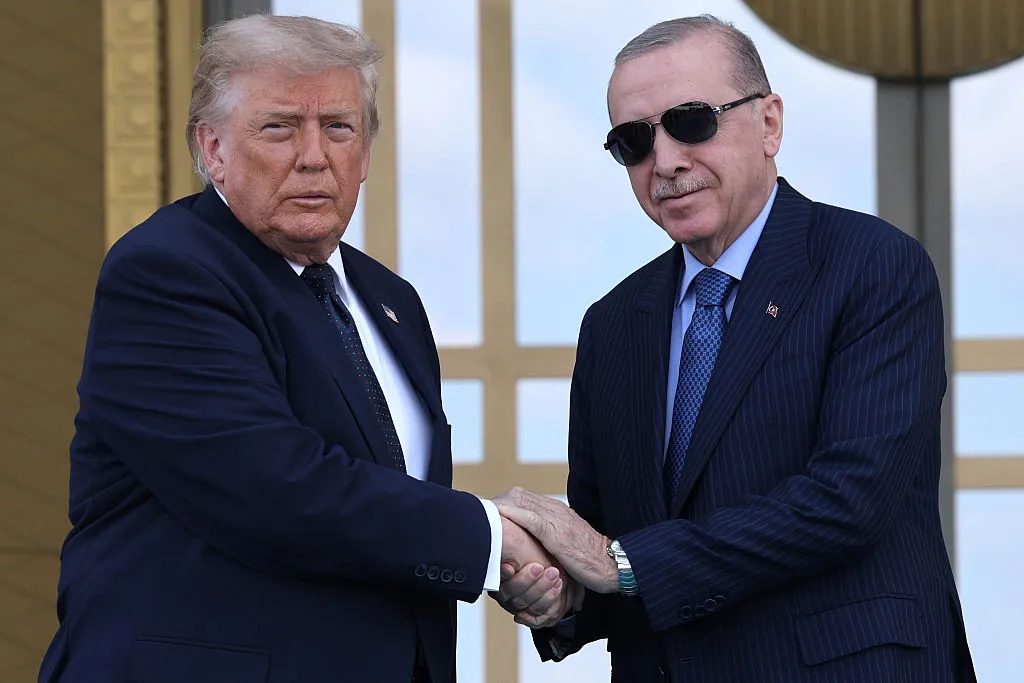
The NATO summit in Ankara unfolded as a carefully choreographed display of Turkish hospitality and authoritarian efficiency. Journalists were greeted with Turkish delights, perfumes and porcelain coffee cups, while white Angora kittens roamed the press centre. Freshly paved roads and punctual shuttle buses completed the picture. Behind the spectacle lay staggering security: roughly 70,000 personnel guarded the event, almost double the presence at last year's summit in The Hague. In the weeks before the gathering, authorities banned all protests and arrested hundreds of NATO critics and left-wing activists.
While Donald Trump praised the arrangements, some liberal Atlanticists present expressed discomfort at what they viewed as a deviation from the democratic values supposedly intrinsic to the alliance. A more accurate reading, however, would recognise Ankara as NATO returning to its Cold War roots.
The architecture of NATO 3.0
In recent months the Trump administration has advanced the theme of NATO reverting to its original purpose: European deterrence and defence. The concept, branded "NATO 3.0", emerged in February as the brainchild of Elbridge Colby, Undersecretary of War for Policy, a self-described restrainer who advocates limiting military interventionism. Colby has faced criticism from liberal Atlanticist circles and was reportedly subject to surveillance by Israel.
"A return to and validation of its foundational purpose,"
Colby describes the project, adding that it amounts to "make NATO great again" by ensuring Europeans pour billions into defence industrial production and technological innovation so they can handle their own conventional, non-nuclear defence.
At the summit the transition to NATO 3.0 played out in real time. Senior officials spoke repeatedly of building "a stronger Europe in a stronger NATO>" and cited figures showing leaps in European defence spending aligned with Trump's demands. One senior official described the "simultaneity problem", the administration's concern that the US military could be forced to fight multiple major conflicts at once, as the reason "why Europeans are stepping up and taking more responsibility for their own defence". Whatever their distaste for Trump's rhetoric, allies and officials are now taking the administration's words seriously.
Spending ultimatum and the Defence Industry Forum
Weeks before Ankara, Pete Hegseth, Secretary of War, echoed Colby at the NATO defence ministerial in Brussels. He tied NATO 3.0 directly to Washington's spending demands.
"That's what defence spending commitments are all about, transforming NATO into a real military alliance that's focused on hard power and real deterrence, a NATO 3.0 modelled on the NATO 1.0 that won the Cold War."
Hegseth issued an ultimatum: future American NATO dues would depend on allies meeting their own defence spending targets. "Where other allies do not spend with urgency, our dues contributions will go down," he warned, adding that a review would follow in six months. The threat amplified anxiety in Ankara, especially given the administration's broader retreat from multilateral bodies. In January the United States withdrew from 31 UN entities and is withholding around $4 billion in mandatory UN dues.
From Cold War origins to mission creep
Understanding NATO 3.0 requires tracing the alliance's evolution. NATO 1.0, founded in April 1949, was a firmly right-wing organisation centred on strengthening American dominion over Europe and confronting the Soviet Union. Its founding treaty promised to "safeguard the freedom, common heritage and civilisation of their peoples, founded on the principles of democracy, individual liberty and the rule of law". Yet founding members included Portugal under dictator Antonio Salazar, whose Estado Novo regime outlawed opposition parties and ran a menacing secret police.
The United States championed the entry of Franco's Spain, seeing its strategic location and anti-communist fervour as ideal. When European allies objected, Washington signed the 1953 Pact of Madrid, furnishing the dictatorship with aid and securing US bases on Spanish soil. French colonial Algeria also fell under Article 5, despite systematic torture and concentration camps. Former Wehrmacht officers were integrated into the alliance, some rising to senior leadership. In the face of the Soviet threat, there could be no enemies to the right.
NATO 2.0 covered the "long Nineties", marked by end-of-history hubris, rapid eastward expansion, and zealous out-of-area operations that undermined the alliance's claim to be purely defensive. The 1999 bombing of Yugoslavia forced Serbian forces from Kosovo but did not topple Slobodan Milošević; his former information minister Aleksandar Vučić has led Serbia in various capacities for 14 years. The 2011 intervention in Libya, sold as humanitarian protection, pursued regime change. A Harvard Belfer Center report concluded that NATO's action "magnified the conflict's duration about sixfold and its death toll at least sevenfold". The Global War on Terror added non-state actors as threats, spawning costly cross-border occupations. If NATO 1.0 contained the Soviet Union in Europe, NATO 2.0 represented the mother of all mission creep.
Turkey as the model ally
The Ankara summit responded to Trump's demand for a scaled-back, Europe-led pact. It opened with a Defence Industry Forum where Secretary General Mark Rutte repeatedly invoked a "defence industrial revolution". The event allowed Turkey to showcase its indigenous defence industry and gave European allies a stage to demonstrate compliance with Trump's spending dictates.
Volodymyr Zelensky addressed the forum, likening the current drone revolution to the invention of missiles. He described Ukraine as a reluctant defence industrial powerhouse forged in war and argued it should therefore join NATO. A NATO official confirmed "at least" $50 billion in new defence deals, including $40 billion for counter-drone capabilities and multi-country initiatives for the militarisation of space.
Turkey embodies the NATO 3.0 ideal. Though it contributed to NATO 2.0 peacekeeping in Kosovo and Bosnia, President Recep Tayyip Erdoğan, like Trump, rejects liberal internationalist pieties. Both want the alliance stripped to raw essentials of defence and security, discarding democracy promotion. Turkey fields NATO's second-largest army and a booming defence industrial base: exports exceeded $10 billion last year. Throughout the summit Trump lavished praise on Erdoğan.
"Really a great man, a great leader, and a strong person."
The affinity signals that NATO 3.0 values deterrence capacity above democratic credentials in allies perceived to be pulling their weight.
Costly summitry and the rhetoric of security
Elements of NATO 2.0 persist, notably the annual summit. During the Cold War the alliance held just ten summits; today it convenes a wildly expensive gathering every year. Last year's meeting in The Hague reportedly cost about €1 million per minute, possibly the most expensive in alliance history. Preparations for Ankara reportedly cost €235 million. International relations scholar Patrick Porter warns that regular summitry creates "relentless opportunities for trouble and mischief and misunderstanding", a critique now shared by some allies. Rutte confirmed the next summit will be in Albania but would not commit to a 2026 date.
Striking differences separate NATO 3.0 from its Cold War predecessor. NATO 1.0 justified itself with the platitudes of prosperity and liberty, propaganda, certainly, but integral to winning an ideological battle that once divided the world. Now the rhetoric of prosperity and freedom has given way to the cold, uninspiring promise of "security", a nebulous, constantly expanding concept emblematic of an ideology that has lost the ability to excite or be believed, and must rely on coercion, censorship and repression to prevail. While the alliance holds lavish summits and member states ramp up spending for a "defence industrial revolution", citizens in allied countries are told they must endure brutal cuts to health care, education and social welfare to foot the bill. Boosters claim NATO "protects one billion people". If it does, it does so at a steep cost.