
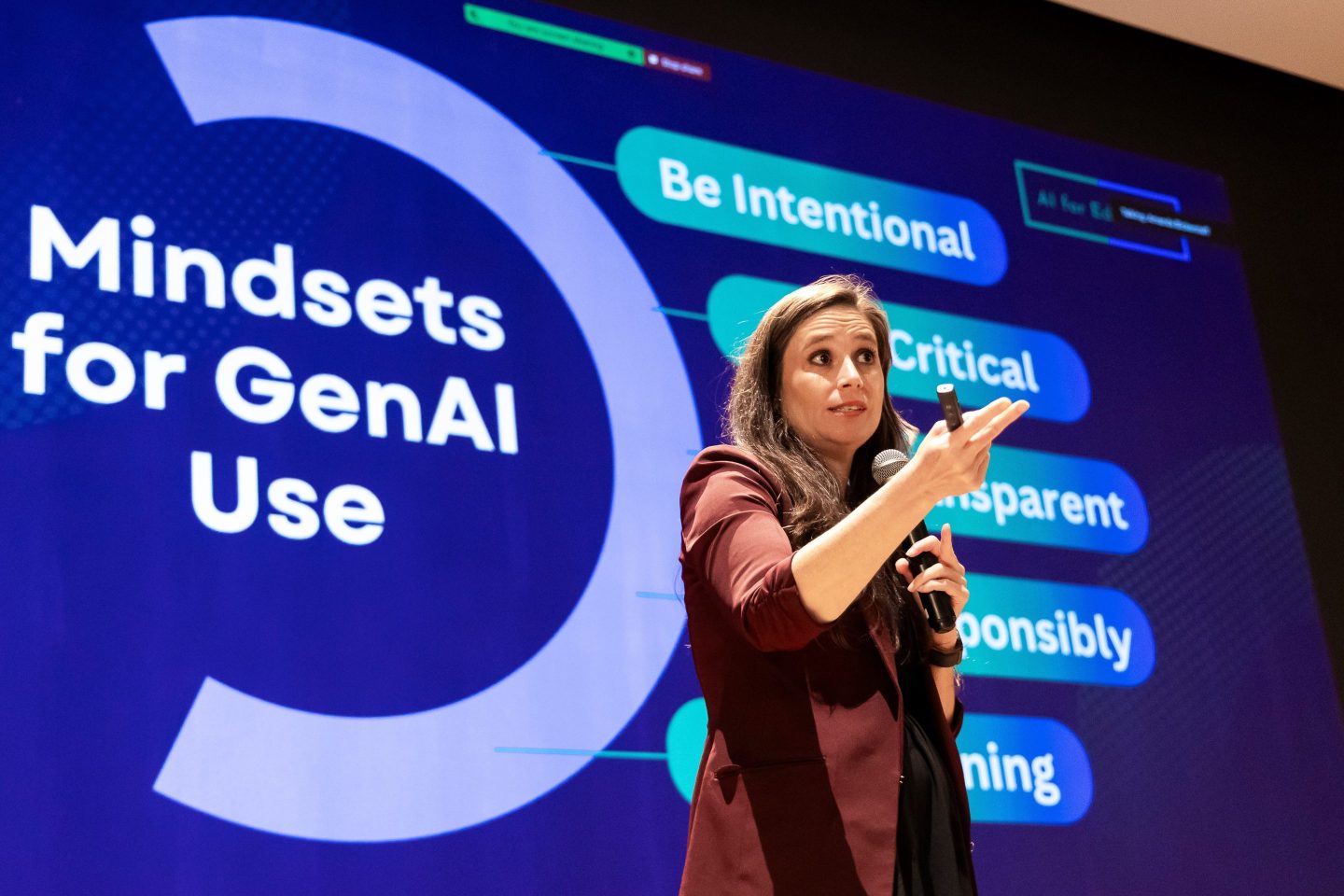
In a packed auditorium at a Charleston, South Carolina high school, teachers and principals watched an artificial-intelligence chatbot attempt to draw a map of the world. The result was a screen full of misspelled country names, Mali appeared as "Mail", Egypt as "Sopth", and Libya was simply labelled "Africa". The demonstration, organised by Amanda Bickerstaff, founder and CEO of AI For Education, was intended to show how easily students can be misled by generative AI.
Why the demo matters for classrooms
Chatbots such as ChatGPT are increasingly used by students for research, essay drafting and coding assistance. Yet they are prone to "hallucinations", fabricating information that looks plausible but is outright wrong. By exposing the absurd errors of a simple map request, Bickerstaff gave educators a vivid example of why blind trust in AI tools is dangerous.
"If you ever want kids not to over-trust these tools, try the map demo," Bickerstaff said.
Experts agree that AI literacy must go beyond learning how to prompt a model. Rebecca Winthrop, director of the Center for Universal Education at the Brookings Institution, stresses that students need to know when not to use AI. "Good AI literacy includes knowing when not to use it," she explained.
Local response: Charleston County's two-phase plan
The Charleston County School District, the second-largest in South Carolina with about 50,000 pupils, has taken a self-directed approach. Deputy superintendent Lucas Clamp said the district first drafted an AI policy after consulting teachers, parents and students. Focus groups revealed that AI use was widespread but unregulated.
Phase two, which begins as the new school year starts, will deliver a mix of online and in-person training for teachers and middle- and high-school students. The curriculum includes scenarios such as asking a chatbot for research help, followed by a reminder to verify any factual claim. A data-privacy module warns against sharing personal details, noting that conversations can be stored and used for model training.
High-school teacher Ray Knauer, who attended the summer training, plans to use AI-bias examples in his AP Research class. "We are all trying to figure out the right balance so we don't scare students away from AI but we also don't encourage them to run to it," he said. "Students need to analyse answers rather than accept them at face value."
State-level initiatives and the risk of a patchwork
While South Carolina has no statewide AI guidance, 37 US states have published official frameworks. Utah leads with a dedicated AI education specialist, Matt Winters, appointed in 2024. Winters has trained over 7,000 teachers and helped districts develop policies required by state law by July 2027.
"There is a clear method from the top in Utah," said Chris Agnew, director of the Generative AI for Education Hub at Stanford University. Other states such as Maine, West Virginia and Georgia have followed Utah's example, creating full-time roles to oversee AI integration.
Nevertheless, the United States still faces a patchwork of approaches. Rural districts often lack the resources for extensive training, prompting initiatives like the $500,000 grant that enabled Emma Moss's team from the Canyons School District to deliver over 150 AI-literacy sessions across Utah.
What lies ahead for AI education
Nationally, studies show a majority of teenagers and teachers are already using AI for schoolwork, largely without formal instruction. As districts like Charleston County roll out their training programmes, the hope is that students will develop critical skills to evaluate AI output, understand bias and protect their data.
State education boards are also working to shift mindsets. Kristina Yamada, digital-technology specialist for the Utah State Board of Education, argues that teachers must move beyond fearing cheating and instead teach students how to use AI responsibly. "People can lie. A program can lie. A robot can lie," she said, highlighting the need for early conversations about AI honesty.
With AI tools becoming a permanent feature of the learning environment, the combined effort of local districts, state policymakers and national experts aims to turn a technology that can mislead into one that empowers informed, analytical learners.