
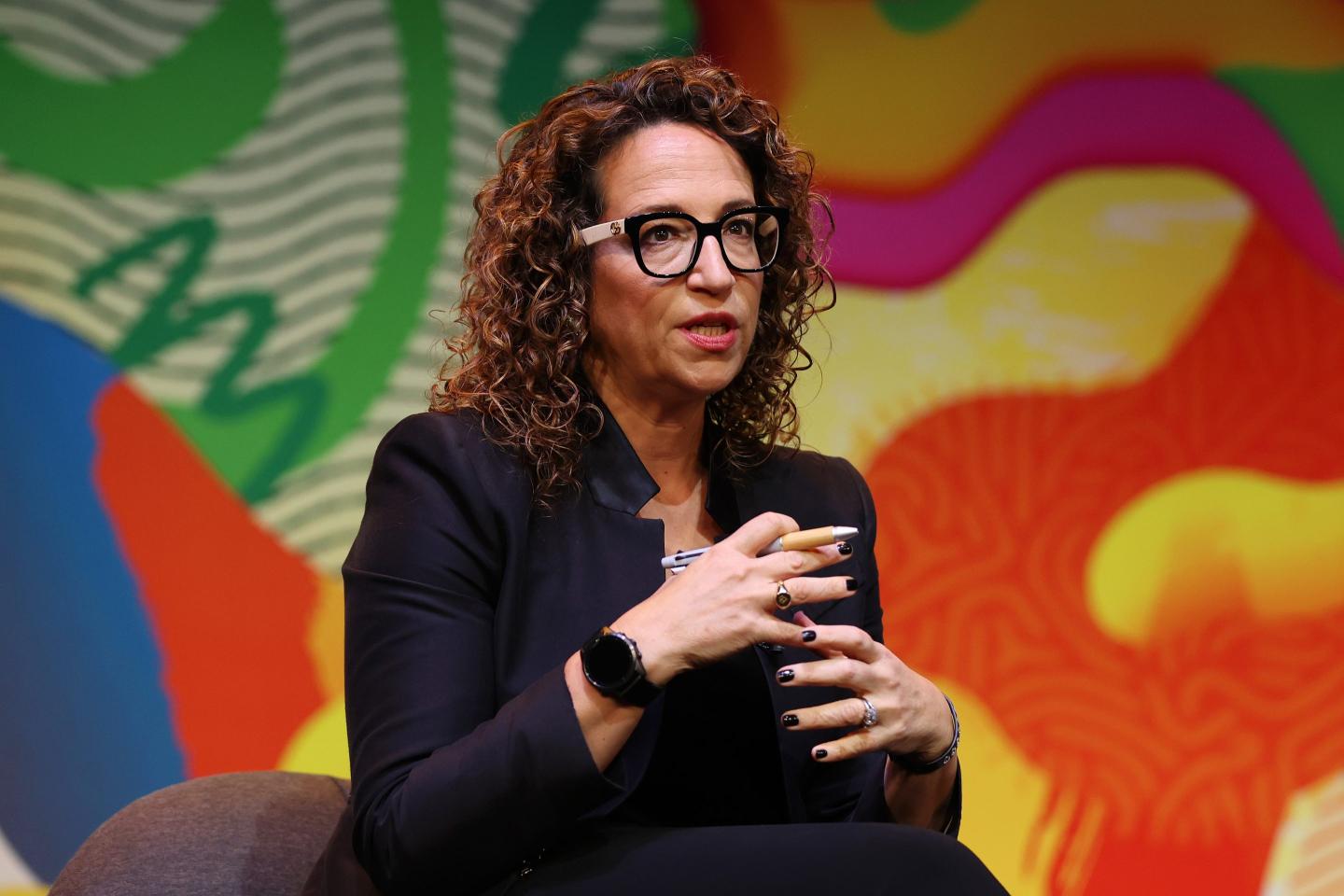
Amy Webb, founder of the Future Today Strategy Group and lecturer at NYU Stern School of Business, told EuroHerald that the rush to adopt generative AI may be creating a corporate bubble. She said CEOs she talks to are buying "abundance" but are not budgeting for the downstream costs that that abundance creates.
Why the AI rush feels like a bubble
Webb, who wrote The Big Nine about the dominance of US and Chinese AI giants, observes that AI makes the production of content cheap, yet it makes everything else in a firm more expensive. She likens the current climate to the fatigue many users feel with dating apps, endless pilots that never mature into lasting solutions.
"The best thing for a dating app is to never get married," Webb said, adding that executives are stuck in "pilot purgatory" with "enormous productivity but not sure what to do with that."
Venture capitalist Marc Andreessen recently warned that large firms are over-staffed by up to 75 % and are using AI as a "silver bullet excuse" for cuts that stem from pandemic-era hiring. An Oxford Economics analysis found AI-related layoffs accounted for only 4.5 % of total US job losses, despite the media hype.
Hidden costs behind the hype
Webb says the problem is not a lack of investment but a mismatch between short-term excitement and long-term integration. Companies run dozens of generative-AI pilots without embedding them in legal, IT or workflow structures, leading to repeated start-ups and rising expenses.
One client, she noted, launched 14 or 15 pilots this year, applying Amazon's two-pizza rule to keep teams small, yet none scaled. The result was a lot of "pizza" and a lot of wasted money.
A Bain & Company survey of 951 global firms found that almost 40 % of those measuring AI cost savings fell short of a 10 % reduction, even though they aimed for 11-20 % returns. Despite the shortfall, 90 % of respondents said they would increase their AI budgets.
Decision overload and "insta-decks"
Executives also report decision paralysis caused by an overload of AI-generated presentations. One manager described "insta-decks", slides that used to take a week now produced in a day, but in five times the quantity. Webb added that tools like Claude often generate overly verbose output, producing ten pages when one would suffice.
She asks CEOs: if AI freed up 10 % of total capacity tomorrow, where would that capacity be deployed? So far, she says, few have an answer, and the productivity gains are not being harvested into new strategic thinking.
When might the correction arrive?
Webb expects the first cracks to appear as early as next year. She predicts that within two quarters few companies will be able to demonstrate measurable change, and Wall Street will begin questioning the flood of generative-AI pilots.
She cautions that this is not a classic dot-com bubble. The abundance of AI tools brings new, unaccounted-for costs that could make the correction more painful than a simple market crash.
Why the mismatch matters
Webb notes that many CEOs were not hired for AI expertise; they are seasoned executives tasked with steering a technology that is an umbrella for many disparate tools. Planning, she says, requires data, not gut feeling.
Psychologists studying "cognitive offloading" find that when AI takes over core reasoning, people feel less ownership of the output, a trend visible in debates over creativity in Hollywood and media.
If the pressure to adopt AI continues while leaders remain inexperienced, the outcome could be far worse than a financial bust. Webb jokes that she might start calling the phenomenon an "AI hallucination" in her classes.
Her own consultancy, however, is thriving. "When there is horrific uncertainty out there, uncertainty is what we do," she said.