
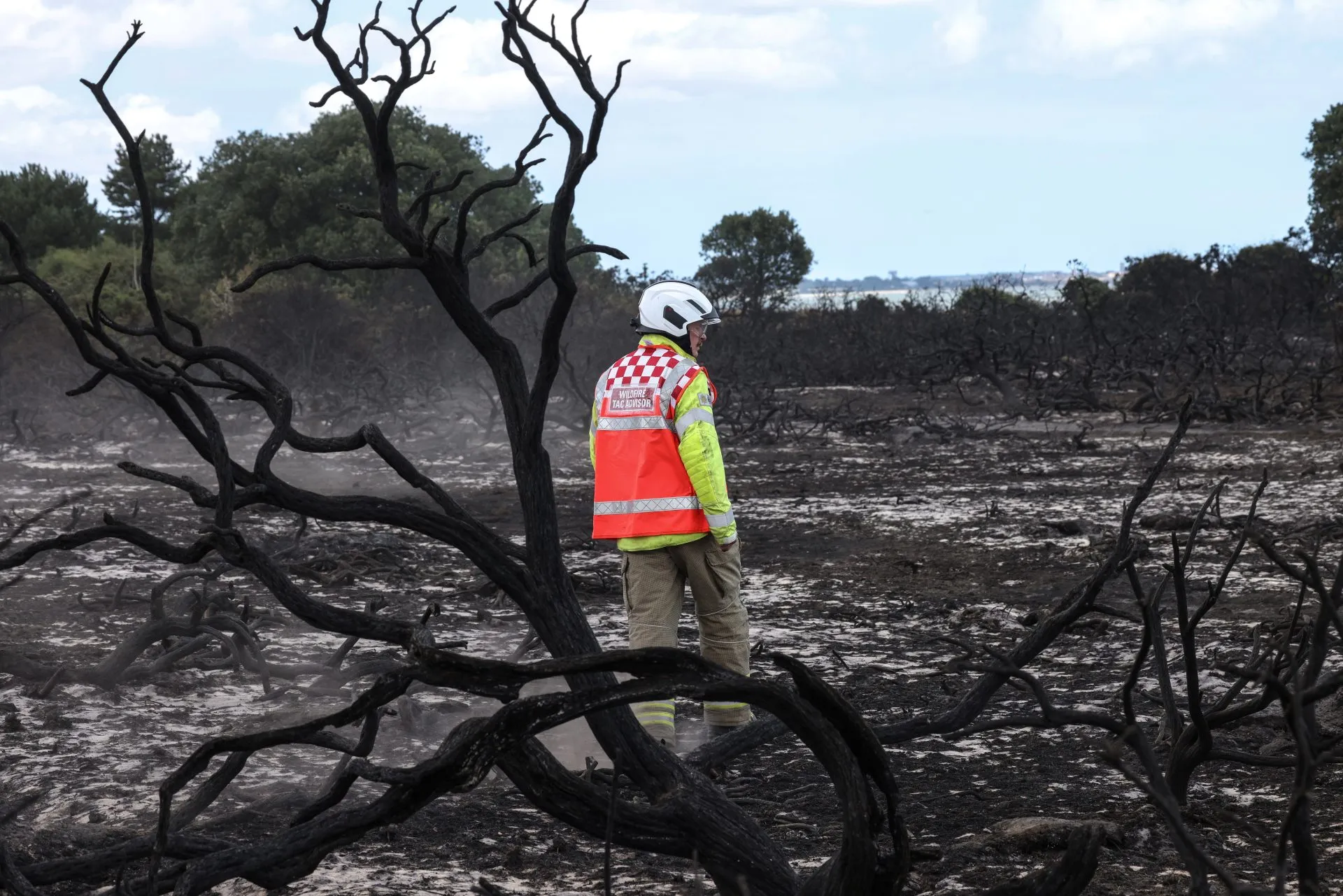
A four-day wildfire on the Suffolk coast has consumed 150 hectares of heath and woodland at Dunwich, forcing the evacuation of nearby villages and holiday parks. The blaze, fuelled by weeks of drought and successive heatwaves, has been contained by local fire crews but conservationists warn that local ecologies may require 25 years to recover.
A landscape shaped by loss
Dunwich today is a tiny coastal village of around 200 people, a chip shop and an annual influx of cyclists for the overnight Dunwich Dynamo ride from London. Yet beneath its modest present lies a profound history. During the Anglo-Saxon period, before the Norman invasion, Dunwich served as capital of the Kingdom of the East Angles. A thriving port covering an area comparable in scale to medieval London, though smaller in population, it was recorded in the Domesday Book with three churches and an estimated 3,000 inhabitants.
In the 13th century a Franciscan friary was established on the nearby headland. Then climate disaster struck. A storm surge in the late 13th century repeatedly battered the region, flooding the port and gnawing at the coastline. The harbour silted up, the shore changed shape, and crucially the river that had been the town's reason for existence shifted course, moving more than a mile away. Dunwich lost its purpose. Further floods swept homes into the sea. No one rebuilt them; people moved on.
Thin places and enduring myths
The ruins of the friary remain visible on the headland, where visitors report strange lights, known locally as Hobby Lanterns or jack-o'-lanterns, and ghostly monks pacing the stones. A persistent legend holds that on foggy nights the bells of the submerged churches can be heard ringing beneath the waves. These stories reflect a wider tradition that identifies Dunwich as a "thin place": a location where the boundary between the ordinary and the uncanny feels permeable.
Such places are more commonly associated with Wales, Cornwall and Scotland, the uplands and borderlands less thoroughly mapped and subdued. Yet Suffolk's big skies and estuarine landscapes, where sea and sky, fresh and salt water blend imperceptibly, have long drawn artists, writers and composers seeking that same liminal quality. The curlew's cry, half-rotted wood sunk in mud, limpets and moss: these are English thin places that speak to a national psyche torn between love of home and longing for the open horizon.
Fire as continuation, not departure
The recent fire, though devastating, can be read as a continuation of Dunwich's ancient story rather than a departure from it. Centuries ago the devouring sea shrugged off an entire habitation. This time fire drove human inhabitants away. Concrete bunkers along the coast, half-eroded by salt and wind, stand as reminders of a feared seaborne invasion that never came; the earlier ruins mark an invasion borne by the sea itself.
Modern responses to climate change rarely challenge the assumption that technology and regulation can permanently master elemental forces. More solar farms, different vehicles, thicker rulebooks: the product is always more or different stuff. Yet periodically voices argue that the necessary response is not building but attending, listening to what thin places have to tell us. Those voices are seldom heeded.
A wake-up call from deeper England
The land at Dunwich was there when the Anglo-Saxons arrived and will remain long after current inhabitants are gone. However mild and generous it appears, it can still shrug, dislodging whoever happens to be there at that moment. Anyone who claims the right to call this land home would do well to listen, spend time in its thin places, hear what they have to say, and mend their lives accordingly.