
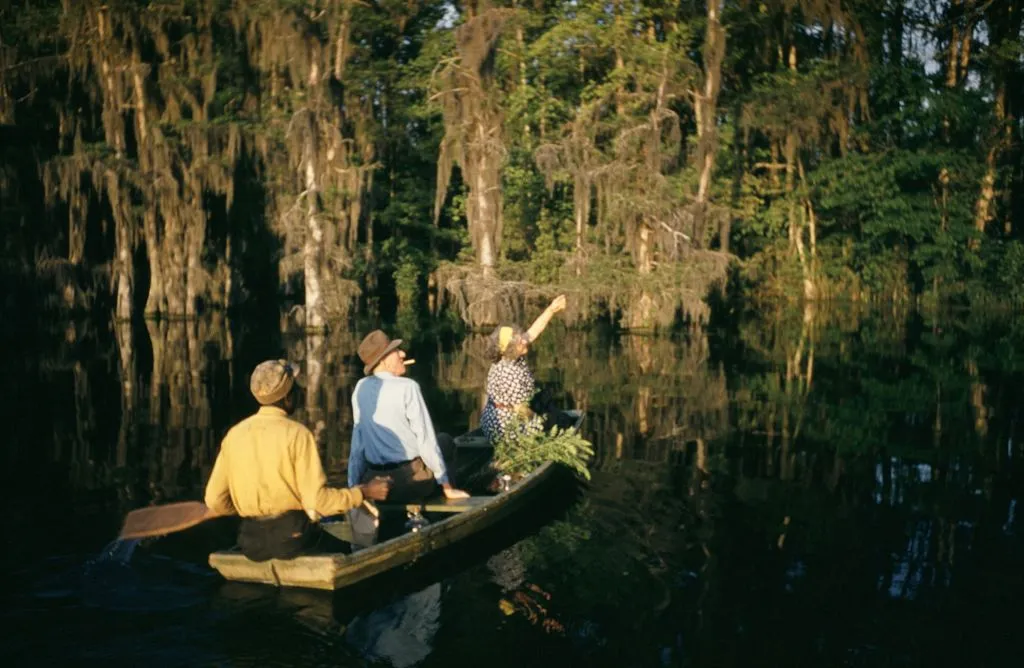
A flat-bottomed boat nosed through the murky water of the Atchafalaya Basin, the largest river swamp in the United States, about ninety minutes west of New Orleans. At the tiller, Keith steered with the confidence of someone who has run these channels since boyhood. Beside him, Tara watched the tree line where cypress blurred into a solid brown-green wall.
An island community
The destination was Pierre Part, a town of roughly 3,000 people on a long stretch of high ground surrounded by wetlands. It is often described as the most French-speaking town in the US outside a village in Maine. The boat passed porches, docks and weathered houses set close to the water. "This is the end of the road," Tara said as the last house on the bank slipped past. Everything beyond was accessible only by boat.
Keith turned into a narrow channel, what locals call a bayou run. Houseboats appeared along the banks. On the porch of a grey cabin, an 82-year-old man smiled and called himself the boogeyman. It was Carlis Goday, Tara's father, lean and upright in a faded denim shirt.
Compact living, deep roots
The couple's houseboat measured no more than 250 square feet. A propane four-burner stove, a single counter and a roll-out grill served as kitchen. A bunk bed, a futon, life jackets, tools and organised piles of fishing gear filled the rest. A flatscreen television and an enclosed bathroom with a toilet were the only luxuries. A small sign on the wall read BORN TO FISH, FORCED TO WORK.
Come summer, the bayou becomes a playground for waterskiing, wake-boarding and swimming in clear pockets before the water thickens to pea green. Snapping turtles and alligators are constant neighbours. "The bigger alligators are usually shy," Keith said. "The smaller ones, you can get closer to, but they won't mess with people." He estimated only two alligator-related deaths in Louisiana in hundreds of years.
From Acadia to the swamp
The Cajun story began on the rugged western edge of France, a Celtic stronghold of sailors who crossed the Atlantic in the early 1600s to settle Acadia, today's Nova Scotia, New Brunswick and Prince Edward Island. They lived close to the water, close to family and the Catholic church, turning salty tidal marshes into farmland.
Neutrality between Britain and France proved impossible. When the British defeated the French, the Acadians refused to swear allegiance to the British Crown, declaring loyalty to God rather than European empires. In 1755 came the Great Expulsion: villages torched, families torn apart, thousands deported. Many died of disease and starvation. No documents written by Acadians during this period have ever been found, leaving the expulsion as much myth as heritage.
Some Acadians drifted back to France, others to the Caribbean. Those who reached Louisiana, still a French colony, found familiar prairies and swamps, difficult enough to deter outsiders and fertile enough to survive, especially with help from Native nations such as the Chitimacha, Atakapa and Houma. The word bayou itself comes from the Choctaw bayuk, meaning small stream. Cajun food absorbed indigenous smoking methods, preservation techniques and seasonings; filé powder, made from ground sassafras leaves, comes from Choctaw cooking traditions.
Enslaved Africans also sought refuge in the wilderness, forming Maroon communities hidden along the swamps. Gumbo's okra-thickened broth has African roots, a stew of cultures simmered for hundreds of years. Through it all, the cultural backbone held: make your own way, stay close to your people, adapt to whatever the land throws at you.
Land washing away
Carlis Goday was not born on the bayou. "I was raised in the French Quarter in my younger years," he said. Asked what the place would look like in twenty years, he answered without hesitation: "No, no. Things are changing too much. Too much erosion."
Hurricanes tear up the land, leaving only tree roots to hold soil together, while storm surge pulls in salt water that kills grasses and hastens decline. "Everything's going," Carlis said, pointing at the water beneath the porch. "Everything's washing away. But this was built when they put in some oil rigs back here."
Most man-made canals were cut by oil companies as inroads for drilling rigs and pipelines, as well as for drainage. The industry employs both Keith and Tara: he does maintenance for offshore platforms, she works as a materials coordinator. One foot in the swamp, the other in capitalism, providing the financial security that lets them live by the rhythms of the natural world.
Hunting the invader
Keith trolled deeper into the channels, scanning tree trunks. "Hoping to go find a big nutria rat to show you," he said. Nutria, an invasive rodent, tear up marshlands, eating vegetation roots and digging holes in levee systems. A state programme pays six dollars per tail during trapping season. "We actually shot a few last weekend, and we ate 'em," Keith said. "They're actually a very clean meat. They're vegetarian." They can weigh five to twenty pounds, roughly the size of midsize dogs.
The boat slowed. Keith cut the motor, reached for a rifle, chambered a round and fired. The crack echoed through the trees. He hopped out, waded into the undergrowth and returned holding a wet, shaggy nutria by its slick ten-inch tail, long orange teeth jutting like chisels. "That's a small one," he said. "My friend calls 'em swamp bunnies."
Self-sufficiency and its limits
Over a nutria stew later, the conversation turned to resilience. "Say the grid goes down," I asked. "Everything stops, no cell coverage. You guys are fine out here?"
"Yeah," Tara said, no hesitation. "We're gonna be fantastic," Keith added, a wide smile spreading across his face.
Fuel and clean water would be the tough ones, they admitted. They would boil water all day if necessary. When I asked about ammunition, Keith paused, trying not to look too pleased. "Eighteen thousand rounds, maybe," he said. Tara laughed: "Always."
Keith did not answer the fuel question. Without fuel, the motorboat, the cooking stove and the backup generator all stop. It is romantic to imagine making it in the wild alone; the truth is that everyone depends on civilisation, only to varying degrees.
News-free by choice
"I watch no news. None," Keith said, sounding proud and defiant. Tara confirmed they had not watched in years. "It would just upset me so much to see all the stuff going on," Keith explained. "How much positive stuff do you see in the news?" "Nothing," Tara said quickly. "So this is what we do, and we enjoy our lives doing it. And if we're not here, we're doing stuff with our families." Christmas brings sixty to seventy relatives for a crawfish boil where everyone brings a dish.
A language fading
Back at the dock, Carlis napped in the afternoon sun. He opened a bottle of homemade muscadine wine, generations of craft bottled inside, stretching back to ancestors in France. "Aah. Tolé, ça c'est bon!" he said after a sip.
Asked whether Cajun culture was under threat, his face tightened. "We're losing it. Back when I was little, just this area here, I'd say 100% of the kids spoke French. Nowadays, you're lucky if you get 25% to 30%. Just like my grandkids. They understand it, but they never wanted to talk it."
French was his first language. In school, they made him stop speaking it. Only in recent years have French immersion programmes returned the language to classrooms. The pendulum swung from pushing out French influence, anglicised street names, English-speaking clergy, punishment at school, to a cultural revival in the 1960s with music festivals, immersion programmes and a state agency for Francophone Affairs. But children speak the language of their friends and the TikTok videos they watch.
Swamp-to-table
Tara lifted the pot lid as the stew roared, steam rising rich and heavy. Plates in hand, we ate in the open air. The meat was earthy, dense, close to rabbit or dark chicken, with a gummy texture and a kick of spice.
"Big question is, would you eat it?" Keith asked.
"If I was out here, yeah," I said. They both laughed.
As the cardinal's whistle carried across the water, the bayou offered peace, but the next storm could strip everything away. For now, Keith and Tara navigate both worlds, their survival skills honed by generations who made a home where few others would stay.