
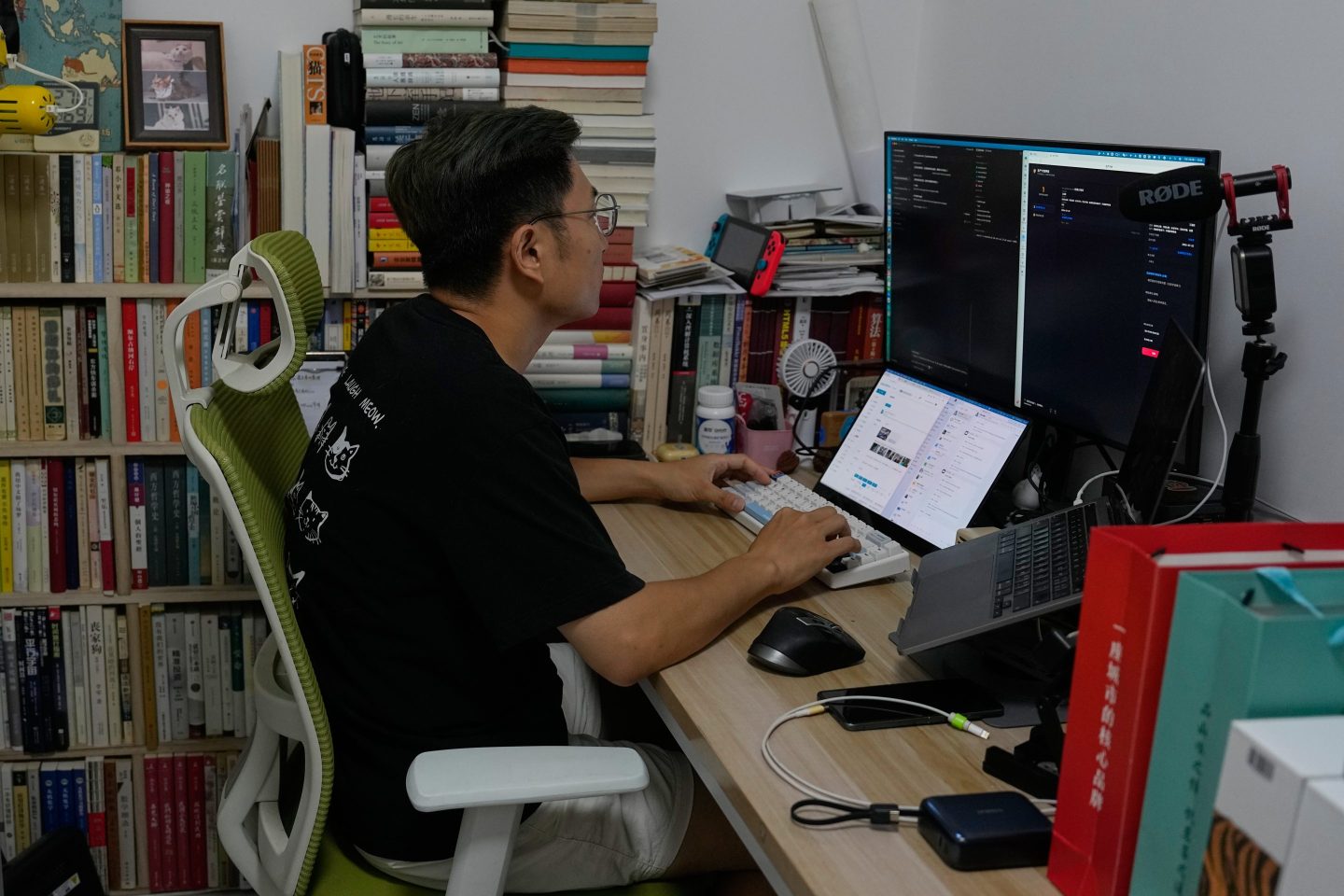
Fei Zhaojun, a 40-year-old computer programmer in Beijing, was asked by his manager whether artificial intelligence could soon replace human coders. Two weeks later he and roughly 160 colleagues were told their positions were redundant.
AI-driven layoffs in Beijing
The incident reflects a growing pattern across China, where government policies actively promote the use of AI and robotics in industry and everyday life. Companies are increasingly turning to large-language models and code-generation tools, believing they can cut costs and boost productivity.
"Mid-level coders' jobs are essentially replaceable in most cases," said Fei Zhaojun.
Fei, who had previously doubted AI's ability to write flawless code, now acknowledges that the technology is "close enough" for many tasks. While he is not earning an income from his new vlog-style videos about ordinary lives, he hopes the content will help others navigate a shifting job market.
Workers and analysts weigh in
Shujing He, a senior analyst at advisory firm Plenum in Beijing, notes that anti-AI sentiment is relatively low in China. "Most people seem either positive, neutral, or mildly interested in AI," she said.
He adds that those fearing replacement are often eager to experiment with AI-enabled ventures, creating a "striking" level of interest in new business models.
In the translation sector, part-time translator Du Qinchun has found temporary work training an AI model, though he acknowledges that industry pay has fallen by more than half.
Broader impact on the Chinese labour market
According to market-intelligence firm IDC, the share of Chinese industrial enterprises using AI models rose to 47.5% last year from 9.6% in 2024. Yanze Du, IDC's senior research manager in Beijing, says the country's open-source ecosystem is accelerating AI adoption in factories and services.
Robots are already sorting parcels in postal centres, directing traffic, making coffee and delivering food, threatening millions of low-skill jobs. In the short-drama industry, the number of live-action short series fell by about 75% in the first quarter of this year, according to Chinese media reports.
A report from the International Labour Organization warns that women are at higher risk of AI-driven job loss, as they are over-represented in roles more amenable to automation.
Economic and policy context
China's "AI Plus" initiative, embedded in its five-year plan through 2030, aims to embed AI across the economy to gain an edge in the technology rivalry with the United States. Zilan Qian, a research associate at the Oxford China Policy Lab, observes that the Chinese government is pushing AI diffusion faster than many other nations.
Economic growth has slowed, with consumer spending dampened by job-security concerns and a prolonged housing market downturn. Eswar Prasad, professor of economics at Cornell University, cautions that while AI will boost productivity, it could exacerbate employment challenges and strain social stability.
Urban unemployment hovers around 5%, but for 16- to 24-year-olds it is roughly three times higher. Demographic forecasts suggest that by 2050 China will have fewer working-age adults per retiree than the United States, raising the prospect that automation may partially offset a shrinking workforce.
Adapting to the new reality
Some workers are turning AI into a tool rather than a threat. Wang Zhicheng, a former scriptwriter for a children's educational video company, now runs an independent studio creating illustrated books, treating AI like any other software aid.
High-school chemistry teacher Yang Zheng sees AI as a supplement for students, noting that while the technology can make mistakes, it improves over time and offers real-time assistance.
Overall, the rapid rollout of AI in China is reshaping the labour market, prompting both anxiety and entrepreneurial experimentation. The next few years will likely see further displacement, but also the emergence of new roles that blend human creativity with machine efficiency.