
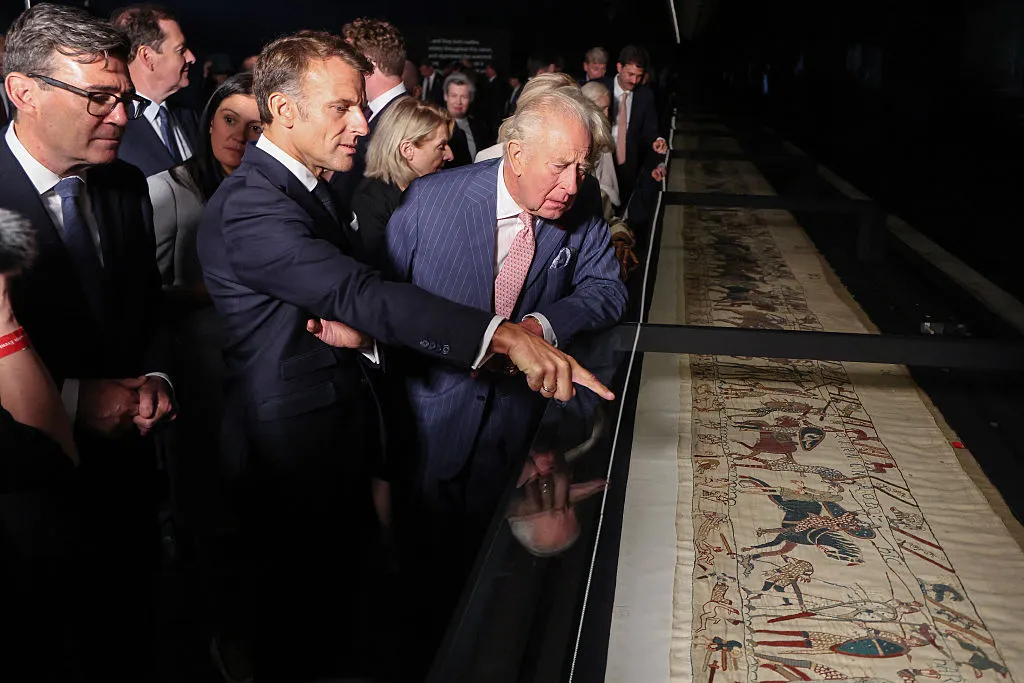
The Bayeux Tapestry, an embroidered narrative of the 1066 Norman conquest, will stay in Bayeux, France, after a petition to loan it abroad was rejected by President Emmanuel Macron. The idea of a temporary loan first surfaced at a 2018 summit between Macron and former British prime minister Theresa May, and resurfaced in July 2025 when a public petition warned of the risks to the fragile work.
Origins and early history
Although now a French national treasure, the tapestry was almost certainly stitched by English embroiderers in the 1070s, a period when English needlework was regarded as the finest in Europe. It is believed to have been commissioned by Odo, Bishop of Bayeux, William the Conqueror's brother-in-law, rather than by William's wife Matilda. The first recorded mention appears in a cathedral inventory of 1476, and the work survived the iconoclasm of the 1562 Protestant riots, possibly because it was hidden in a chest.
The tapestry as a diplomatic tool
Like the Mona Lisa, which arrived in France with Leonardo da Vinci in 1516 and was loaned to the United States in 1963 as a goodwill gesture, the Bayeux Tapestry has been used to signal cultural goodwill. In the early 1960s, French Minister of Culture André Malraux agreed to the Mona Lisa loan after a personal appeal from Jacqueline Kennedy. Macron's 2025 proposal aimed to replicate that soft-power gesture at a time of strained Anglo-French ties.
Past threats and survival
The tapestry has endured numerous crises. During the French Revolution it escaped being repurposed for a republican float, and Napoleon displayed it at the Louvre in 1803 to bolster his planned invasion of Britain. In World War II, the Nazi research unit Ahnenerbe sought to claim the work as evidence of a "Nordic" heritage, but the French Kunstschutz protected it under the Hague Convention. After the liberation of Paris in 1944 the tapestry returned to Bayeux, where it has remained ever since.
Future prospects
With the Bayeux Museum slated for renovation, the French government may consider future loans as part of cultural diplomacy, but any such move will have to balance public concern with diplomatic benefit. For now, the tapestry continues to attract scholars and tourists, serving as a tangible reminder of the intertwined histories of France and the United Kingdom.
"I suppose I am not expected to take any serious notice of some amusing remarks made by Miss Agnes Strickland," a male academic remarked in the 19th century.