
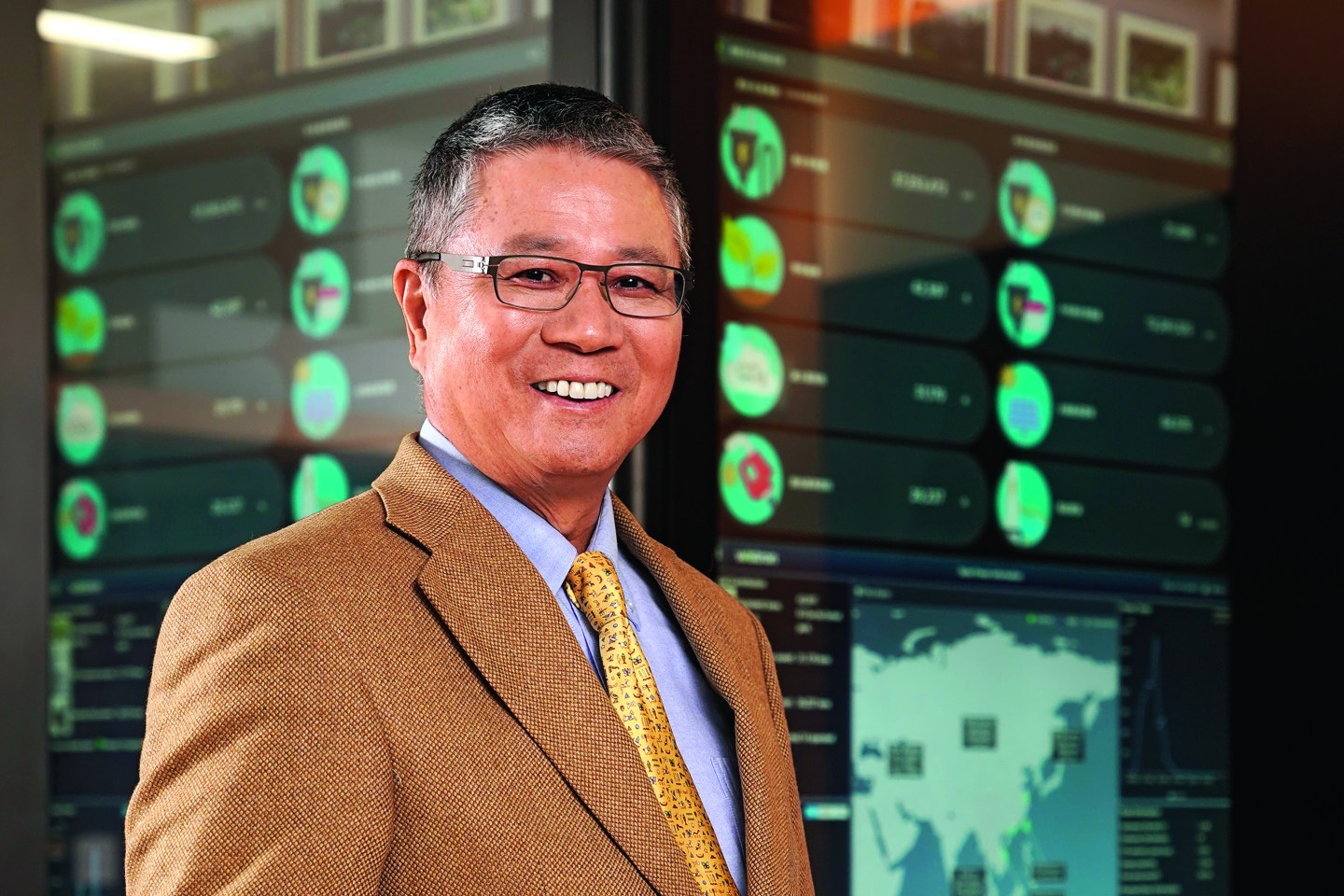
Simon Lin, the 72-year-old chair of Wistron, has overseen one of the most dramatic corporate turnarounds in global technology. The Taipei-based electronics manufacturer climbed 298 places to number 198 on this year's Fortune Global 500, the largest jump on the ranking, after revenue more than doubled to $70.2 billion in 2025. In the first half of 2026 revenue has already reached $55 billion, with servers now accounting for 70 per cent of total sales.
The Nvidia partnership that changed everything
Eight years ago Wistron hitched its fortunes to Nvidia, then primarily a maker of graphics cards for gamers. When OpenAI unveiled ChatGPT in late 2022, demand for Nvidia's processors, well suited to training large language models, exploded. Nvidia turned to longtime partners such as Wistron to build the refrigerator-sized AI server racks that stack multiple processors together.
"These aren't strategic decisions but rather very practical challenges, day and night," Lin says of the scramble to find factory space, hire talent and navigate new supply chains. When Wistron opened a state-of-the-art 287,000-square-foot server plant in Zhubei, northwest Taiwan, last year, Nvidia booked all its capacity through 2026. The company immediately leased a nearby textile factory for rapid conversion to make even more AI servers.
From the bottom of the smiling curve
Lin joined Acer in 1979, a few years after its founding. He is credited by Acer cofounder Stan Shih with coining the "smiling curve" economic model, which argues that the lowest margins sit in the middle of the supply chain, assembly and manufacturing, while higher margins accrue at the design and retail ends. In 2001 Shih spun off Acer's manufacturing division into Wistron and named Lin chair and chief executive.
For years Wistron made PCs for other brands, a commoditised, low-margin business. The 2007 iPhone launch left the company "stuck in the middle," Lin recalls. A brief foray into smartphones, including one of India's first iPhone factories in 2017, ended in 2023 amid low margins and labour unrest at the Karnataka plant. That exit freed Wistron to focus on higher-value AI infrastructure.
Speed of generational change
Lin notes that the product cycle has compressed dramatically. "In the past, one server generation typically lasted about two and a half to three years. You'd spend roughly a year designing a product, then it would stay in the market for about two years," he says. "With AI, not only are there new products every year, but each generation is a revolutionary leap."
Texas expansion driven by tariff threat
Wistron operates facilities in Vietnam, Malaysia, Mexico, Brazil, the Philippines and the Czech Republic, but its most consequential new bet is two complexes near Fort Worth, Texas, covering 1.09 million square feet and dedicated to assembling Nvidia AI supercomputers. The $761 million investment was made official last August after Donald Trump threatened a 32 per cent tariff on imports from Taiwan.
Trump regularly accuses Taiwan of "stealing" from the US chip industry, but Lin rejects the charge. "They threw it away," he says. "Not stealing, okay?" Building in Texas meant shipping all equipment from Southeast Asia because it could not be sourced domestically, and training workers "from scratch." The factories are expected to create more than 800 jobs.
"Even if this decision was slightly forced by tariffs, it became a reasonable one later on," Lin adds, noting that AI servers can weigh upwards of six tonnes, making air or sea transport difficult.
A chair who acts as corrective
Lin stepped down as chief executive in 2022 but remains chair. He once described himself as a "somewhat lazy CEO," meaning he prefers to focus on a few critical issues rather than spread his attention thin. "When the company is doing well, I act as a devil's advocate. I try to remind the management team where we could be wrong," he says. "When people feel discouraged or the company is going through a difficult time, I take on the role of a cheerleader. I always say, 'Tomorrow will be better.'"
For an executive whose firm's frenzied growth comes from AI, Lin admits he does not rely on the technology heavily himself, using it mainly for research. "I'm not sure whether it's so intelligent that it can replace me to make a decision," he says.
What comes next
With Nvidia's order book full through 2026 and Texas production ramping up, Wistron's immediate challenge is execution at scale. The company must maintain quality across geographically dispersed factories while the underlying technology refreshes annually. Lin's focus remains on keeping Wistron ahead of the next generational leap, whatever form it takes.