
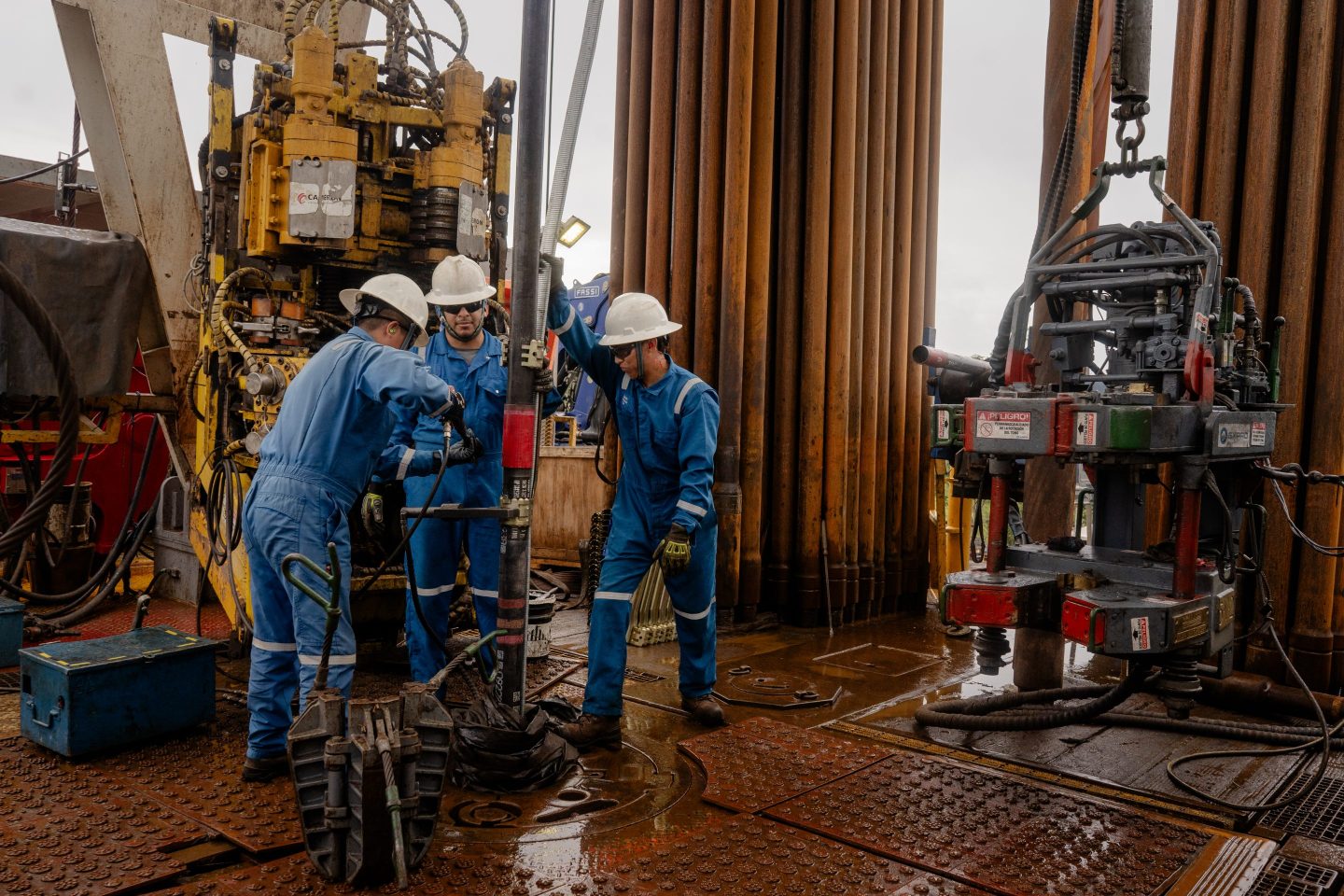
SLB, the world's largest oilfield services company, is poised to benefit from two converging forces: a resurgence in oil exploration driven by Middle East supply disruptions and booming demand for digital infrastructure to power artificial intelligence. Chief executive Olivier Le Peuch says the company's long history of operating in unstable regions and its expanding technology portfolio place it at the centre of a new energy upcycle.
A century of subsurface innovation
The company traces its origins to 1912, when French physicist Conrad Schlumberger conducted electrical conductivity tests on his family's Normandy estate to locate buried ruins. The method proved effective for mapping underground structures and, more profitably, for finding oil. Conrad and his brother Marcel Schlumberger developed the first electric well logs, creating the backbone of modern geophysical prospecting. In 1926 they founded the Société de Prospection Électrique, which became Schlumberger and, in 2022, SLB.
Over a century the company expanded into Venezuela, the United States, the Soviet Union and the Middle East, decades before the formation of OPEC. Known in the industry as "Big Blue" for its signature uniforms, SLB now employs 109,000 people across more than 100 countries, a workforce larger than ExxonMobil and Chevron combined.
Geopolitical shock revives exploration
The closure of the Strait of Hormuz in early 2026 removed nearly 20 per cent of global oil and gas supply, draining emergency stockpiles from the United States to China. Nations are now racing to replenish reserves and boost domestic production. "If you want to create an oil upcycle, you shut the Strait of Hormuz and you get one," said James West, head of energy and power at Melius Research.
"The thing about SLB is they don't leave. They don't leave countries when there's a coup or a change in government or a conflict. Every international market is their backyard."
In Venezuela, SLB and Chevron, both of which remained after the Hugo Chávez government expropriated assets, are working with state-owned PDVSA to redevelop the world's largest proven oil reserves. In the Middle East, SLB partners with Saudi Aramco, the UAE's ADNOC and Kuwait Petroleum.
Le Peuch, the first French chief executive since 1986, describes the current environment as "geopolitically complex" but familiar. "We are very used to this," he said. "It's part of who we are. It's part of the routine, unfortunately, that we have learned to live with crisis management."
Digital division targets AI data centre boom
While traditional drilling and well construction remain core, SLB's fastest-growing segment is digital and data centre solutions. The company launched the first corporate intranet on the Arpanet in 1985 and partnered with Nvidia in 2008. Today its autonomous geosteering systems drill thousands of feet without human intervention.
Leading hyperscalers plan to spend roughly $710 billion on North American data centres in 2026 alone. SLB is focusing on digital power management and modular data centre construction, helping clients standardise server racks, cooling systems and off-site manufacturing to build faster and operate more affordably.
"All these companies jumped very hard into whatever they could do for data centres, which ended up being supplying power, but SLB is digitally optimising not only the power, but the entire operation. They've clearly taken the lead in that."
Analyst Jim Wicklund, managing director at PPHB, said SLB has moved beyond simply supplying power to optimising the full data centre stack.
Volatility and the path ahead
Despite its scale, SLB's market capitalisation sits near $75 billion, well below its 2015 peak and far behind integrated majors such as ExxonMobil at $600 billion. Service companies absorb sharper downturns when oil prices fall. "They are the end of the whip in terms of volatility," Wicklund said. Efficiency gains have also compressed revenue per well; a job that once took 30 days now takes less than a week.
Yet the name change to SLB in 2022 signalled a deliberate shift toward technology. The company is also expanding into geothermal energy, carbon capture and lithium extraction. Le Peuch argues that clean energy innovation remains central to the mission even amid an oil boom. "The customer trusts us to innovate in the most remote, the most complex environments, as well as whenever there is an opportunity to disrupt through a new technology," he said.
Family legacy and corporate governance
The founding families, the de Menils and the Seydoux, have largely stayed out of operations. François de Menil, grandson of Conrad, said his father John de Menil believed the company needed professionals, not family members, a discipline he credits for its longevity. The de Menil branch became prominent Houston art patrons, founding the Menil Collection. The Seydoux branch dominates French cinema through Pathé and Gaumont, with actress Léa Seydoux achieving international fame.
As the energy landscape fragments along geopolitical lines, SLB's blend of operational reach, subsurface expertise and digital capability positions it to serve both the revived hydrocarbon cycle and the infrastructure demands of the AI era.