
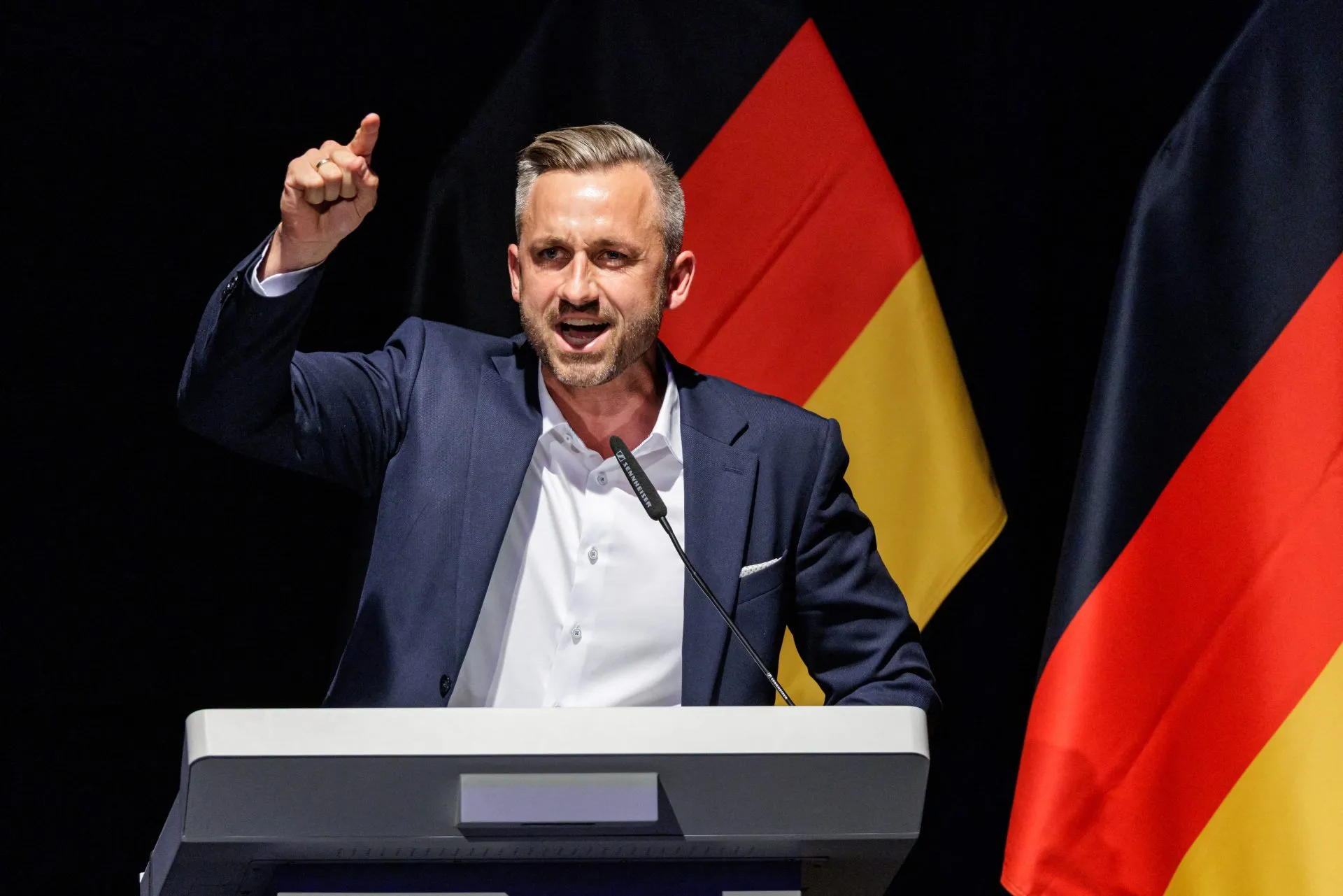
Ulrich Siegmund leads the Alternative for Germany (AfD) into the 6 September state election in Saxony-Anhalt. Recent polls put the party at 43% of the vote, a level that could deliver an outright majority of seats if smaller parties hovering around the 5% threshold, notably the Greens, fail to enter the Landtag.
Election stakes in Saxony-Anhalt
The outcome is a tightrope for the German establishment. An AfD majority would be the first time the party governs a state without sharing power, a feat previously achieved only by the centre-right CDU/CSU and the centre-left SPD. Success in Saxony-Anhalt could also boost the party's prospects in the upcoming Berlin and Mecklenburg-Western Pomerania elections, where the AfD already leads the polls.
Establishment's contingency plans
Berlin's response has moved beyond rhetoric. A report in Der Spiegel featured a cover image of Siegmund with the caption "Germany's most dangerous man", a portrayal that even former Die Welt editor-in-chief Ulf Poschardt criticised as feeding the AfD's narrative of a hostile elite.
Germany's most dangerous man
According to Politico, officials are drafting several scenarios to curb a potential AfD government. One proposal would bar Saxony-Anhalt's minister from meetings of the interior ministers that discuss sensitive security and intelligence matters. Constitutional scholars say such exclusion is "perfectly conceivable", though it could be challenged in the federal courts.
A second idea involves erecting a "wall" within shared information systems, arguing that the AfD's alleged proximity to Russia makes it untrustworthy with classified dossiers. An AfD spokesperson countered, "We talk to everyone, whether West or East, but that does not mean we will hand over files."
A third, financial measure would slash the roughly €3 billion a year Saxony-Anhalt receives from federal fiscal equalisation, about one-fifth of the state's budget, to pressure the party into compliance.
The most drastic option is invoking the so-called "nuclear option", the Bundeszwang. Under Article 37 of the Basic Law, the federal government, with Bundesrat approval, could compel a state to fulfil its legal obligations, a step never used since the Federal Republic's founding in 1949.
Legal and constitutional challenges
In May 2025 the domestic intelligence service classified the AfD as a "confirmed right-wing extremist" organisation, a label that would have unlocked expanded surveillance powers. However, the Cologne Administrative Court blocked the designation in February 2026, finding the legal criteria unmet.
Despite the court's ruling, a 2026 legal opinion from an NGO argued that a ban on the party would likely succeed, and more than a thousand legal professionals signed an open letter urging authorities to pursue the ban.
Implications for German politics
Support for Chancellor Friedrich Merz has fallen to a historic low of 14%, reflecting public discontent with economic contraction, welfare cuts and a hardening stance towards Russia. The AfD's rise, particularly in eastern states, is being driven less by extremist ideology than by frustration with the establishment.
What happens next will test the limits of Germany's "militant democracy". If Berlin proceeds with any of the outlined measures, it risks reinforcing the AfD's claim that the political system excludes dissenting voices. Conversely, a decisive electoral defeat for the AfD would preserve the current firewall but leave open the question of how the establishment will respond to future challenges.
The coming weeks will reveal whether the German constitutional framework can accommodate a democratically elected government that the ruling parties deem unacceptable, or whether extraordinary measures will reshape the balance of power in Saxony-Anhalt and beyond.