
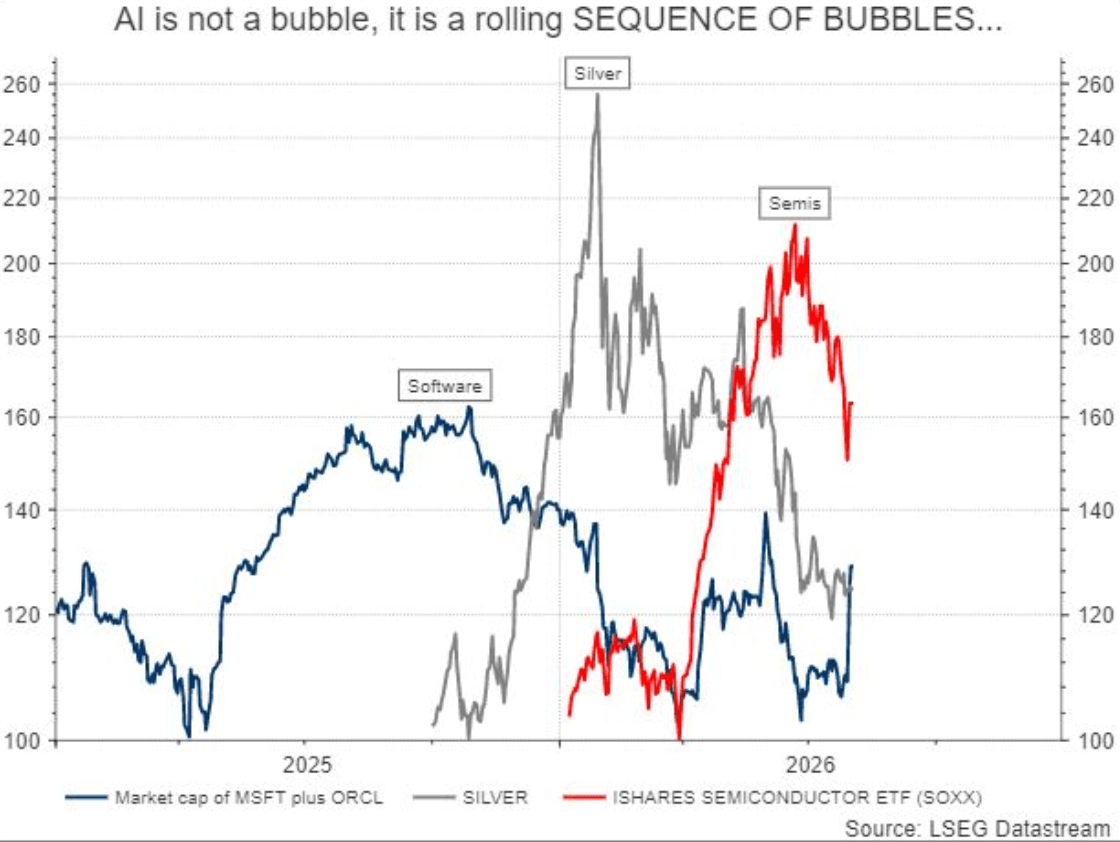
Dhaval Joshi, formerly chief strategist for Counterpoint at London-based BCA Research, has reframed the debate over whether artificial intelligence (AI) is a bubble. In a recent LinkedIn post and an interview with EuroHerald, he argued that the right question is not if AI is a bubble, but which AI-related bubble is inflating and deflating today.
What happened?
Joshi observes that instead of a single, massive bubble building to a dramatic burst, investors are witnessing a rapid-fire series of bubbles that rise and fall in succession. He points to three recent examples.
Software-as-a-Service (SaaS)
Software stocks rallied on the promise that AI would boost productivity, then fell when investors realised AI agents could undermine the subscription model itself. Joshi summed it up: "So, the software boom turned to bust."
Silver
Silver prices surged as the metal was touted as the best conductor for power-hungry data centres. Joshi warned that the near-tripling of the price could not be justified by fundamentals, noting that other conductors are available.
Semiconductors
Chip makers enjoyed a rally on expectations of limitless pricing power, but Joshi argued that profit margins lack durable moats. He predicted, "Astronomical margins will crash back to earth when demand and supply equilibrate, as they ultimately must. So, the semis boom is unwinding, though has further to go."
Why does it matter?
The pattern matters because it signals that market participants are repeatedly over-estimating the value of AI-linked assets, then correcting sharply. Joshi distinguishes this from ordinary price discovery by the speed and magnitude of the swings. "If you can make a fortune in a matter of weeks or months, and, crucially, then lose it all just as quickly or even quicker, then that constitutes a bubble," he told EuroHerald.
High-profile figures such as Jamie Dimon, Sam Altman, David Solomon and Jeff Bezos have all warned of excessive valuations in AI-related equities. A Bank of America Global Fund Manager survey even listed an "AI equity bubble" as the top tail-risk. Recent earnings show that hyperscalers like Google have turned free-cash-flow negative for the first time, while analysts at Reuters estimate that by 2027 the combined capital expenditure of Microsoft, Alphabet, Amazon, Meta and Oracle will outstrip free cash flow.
What happens next?
Joshi expects AI capital expenditure to peak in late 2026 or the first half of 2027. He warns that three developments could break the rolling sequence: a sharp rise in real interest rates or bond yields, a rapid unwind of the capex cycle, or a non-mild recession.
He also tracks a fourth risk, a loss of market "complexity", using a metric derived from mathematician Benoit Mandelbrot's work on complex adaptive systems. According to Joshi, high complexity helps maintain equilibrium; a drop could accelerate the bust.
Looking ahead, Joshi outlines three possible outcomes for AI's value capture. The first mirrors the Web 2.0 model, where firms with strong network effects such as Amazon in e-commerce or Google in search dominate. The second envisions superstar individuals who use AI to slash costs while preserving premium output. The third scenario foresees intense competition eroding margins, leaving the consumer as the ultimate winner.
"That's the million-dollar question!" Joshi said when asked which sector might be the next bubble.
He flagged a surprising candidate: DDR3 RAM, a two-decade-old memory chip that has surged 600 % in under a year, likening the price jump to paying $50,000 for a beaten-up 2007 Toyota Corolla.
While crypto has so far avoided the AI rally, Joshi concedes that a synergy between AI and blockchain could make digital assets a future bubble candidate. For now, he advises investors to stay alert to any asset that inflates sharply in a short period, as each rapid rise may herald the next bubble in the rolling sequence.